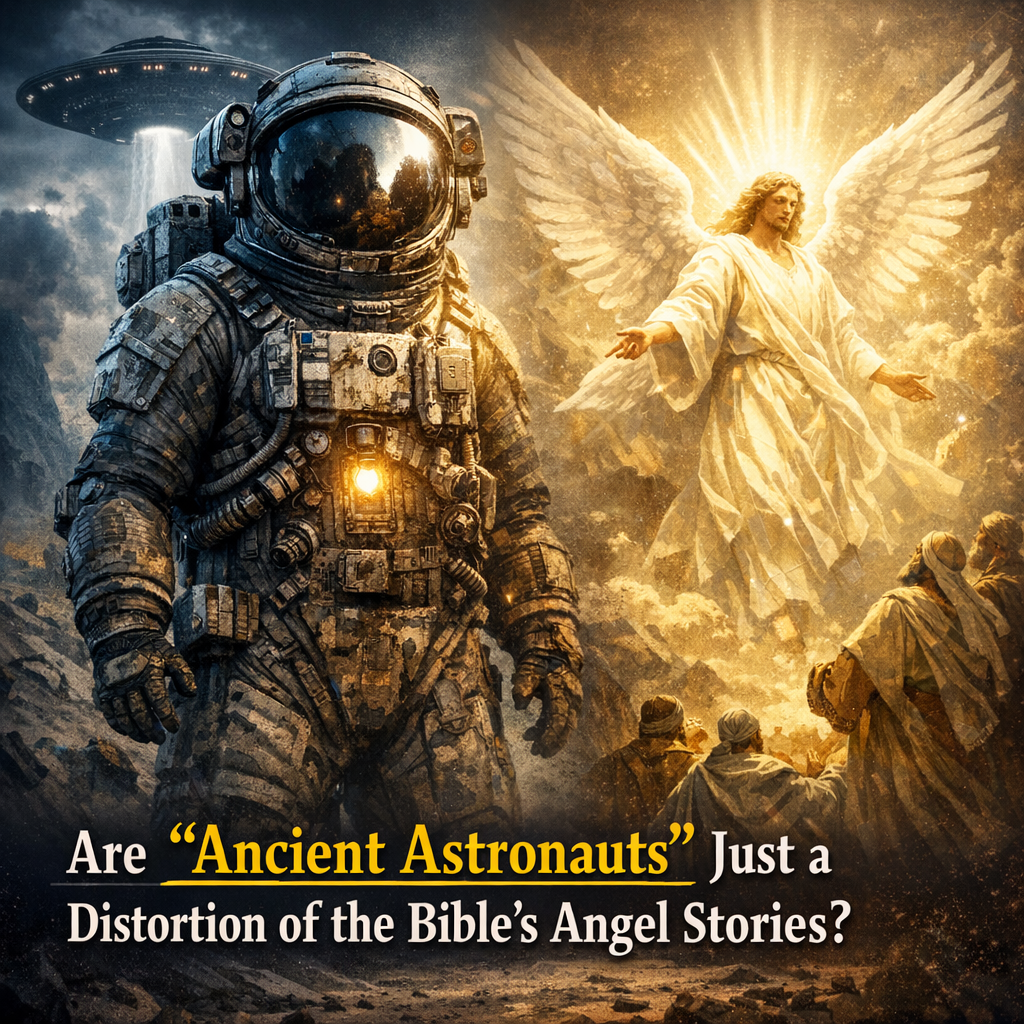
When people talk about “ancient astronauts,” they usually mean the idea that beings from another planet visited the ancient world, gave humanity advanced knowledge, and were later remembered as gods, angels, or mythic heroes. For Christians, the question is not whether the Bible can be squeezed into the latest UFO theory, but whether modern theories are borrowing biblical themes and reshaping them into a secular story. If we are going to talk about UFOs and the Bible, aliens and Christianity, or the Nephilim and aliens, we need to begin where believers should always begin: with Scripture itself.
Why Ancient Astronauts Echo Angel Stories
The ancient astronaut theory often sounds familiar to Bible readers because it overlaps with categories Scripture already gives us: heavenly beings, supernatural rebellion, forbidden knowledge, giants, judgment, and spiritual deception. The theory did not invent these categories. It borrowed them from the biblical narrative and stripped away the theological content, replacing God, moral rebellion, and divine judgment with extraterrestrials, advanced technology, and misidentified spacecraft.
This is exactly what makes the ancient astronaut framework appealing to people who have been exposed to biblical content but resist its theological claims. It retains the drama and mystery of Scripture while removing the God who is sovereign, the Christ who demands allegiance, and the moral accountability that defines the biblical story. In other words, ancient astronaut theory offers a counterfeit that preserves the form of the biblical narrative while emptying it of its substance.
What the Bible Actually Says About Non-Human Beings
The Bible has an extensive theology of non-human intelligent beings. It describes a divine council (Psalm 82, Deuteronomy 32:8–9), angelic messengers (Genesis 18, Hebrews 1:14), cherubim and seraphim (Ezekiel 1, Isaiah 6), spiritual powers and principalities in rebellion against God (Ephesians 6:12, Colossians 1:16), and the “host of heaven” (Psalm 33:6, Isaiah 34:4). These beings are not biological creatures from distant planets—they are spiritual beings created by God, some of whom have rebelled against His authority.
The ancient astronaut framework collapses this rich theological taxonomy into a single category: advanced aliens. Cherubim become pilots. Angels become extraterrestrials in ancient spacesuits. The divine council becomes an intergalactic civilization. In doing so, it flattens the biblical narrative and removes its theological depth. The God who is transcendent, holy, and personally involved in human history is replaced by unnamed beings from another star system who apparently have no moral agenda and no redemptive purpose.
Reading Genesis 6 Before UFO Speculation
Genesis 6:1–4 is one of the most debated passages in the Old Testament and the primary text ancient astronaut theorists use to argue for extraterrestrial visitation. The passage describes the “sons of God” taking “the daughters of man,” producing a group called the Nephilim. The ancient astronaut reading interprets this as aliens interbreeding with humans.
The problem with this interpretation is not that it takes the passage seriously—it is that it takes the passage seriously in entirely the wrong direction. The supernatural interpretation of “sons of God” as fallen heavenly beings has strong support from elsewhere in the Old Testament (Job 1:6, 2:1, 38:7, Psalm 82), from Second Temple Jewish literature (1 Enoch, Jubilees), from the New Testament (2 Peter 2:4, Jude 6), and from early church interpretation. These texts unanimously interpret the event as a transgression by spiritual beings, not as an alien encounter.
More importantly, the moral framework of the passage is spiritual and covenantal, not technological. The text describes boundary-crossing (mixing of categories God separated), divine judgment (the Flood), and divine mercy (Noah). The ancient astronaut reading cannot account for the moral texture of the narrative because it has removed the God who makes moral categories meaningful.
The Specific Distortions Ancient Astronaut Theory Makes
To be specific about the distortions involved, here is how ancient astronaut theory handles key biblical elements:
- Miracles become technology. The parting of the Red Sea was a tractor beam. Manna in the wilderness was alien food supply. The pillar of fire and cloud was a spacecraft. In each case, the personal action of a sovereign God is replaced by impersonal technology from an undefined source.
- Angels become aliens. Abraham’s three visitors (Genesis 18) are described as humanoid aliens scouting the region. The angel who wrestled with Jacob (Genesis 32) becomes an alien combatant testing human physical capability. The incarnation of Christ—the most theologically significant event in history—is sometimes reframed as the arrival of an advanced being from another civilization.
- Judgment becomes intervention. The destruction of Sodom and Gomorrah is reinterpreted as a nuclear strike by alien forces. The Flood is a population control event. The divine moral purpose of biblical judgment is replaced with alien politics.
How Christians Should Respond
Christians engaging with ancient astronaut claims do not need to be defensive or dismissive. The questions these theories raise—about the nature of the Nephilim, the identity of the “sons of God,” the meaning of Ezekiel’s vision, the reality of the unseen realm—are legitimate theological questions that the Bible actually addresses. The opportunity is to go deeper into Scripture rather than retreating from it.
Acknowledge what the Bible genuinely says about non-human beings. Do not pretend the unseen realm does not exist or that supernatural events in the Bible are just myths. Then show how the biblical framework is far richer, more coherent, and more satisfying than the ancient astronaut alternative—because it has a God who is personally involved, a Christ who died and rose again, and a story that is moving toward redemption, not just technological intervention.
Conclusion
Ancient astronaut theory is not a new discovery about ancient history. It is a modern secular narrative that borrows the content of the biblical story and discards its theological meaning. It is not more scientific than the Bible—it simply prefers aliens to God. Christians who understand Scripture do not need to choose between biblical faith and engaging these questions. They are equipped to engage them precisely because the Bible already has answers that the ancient astronaut framework cannot provide: a sovereign Creator, a moral universe, a rebellious human race in need of redemption, and a Savior who entered history to accomplish it.