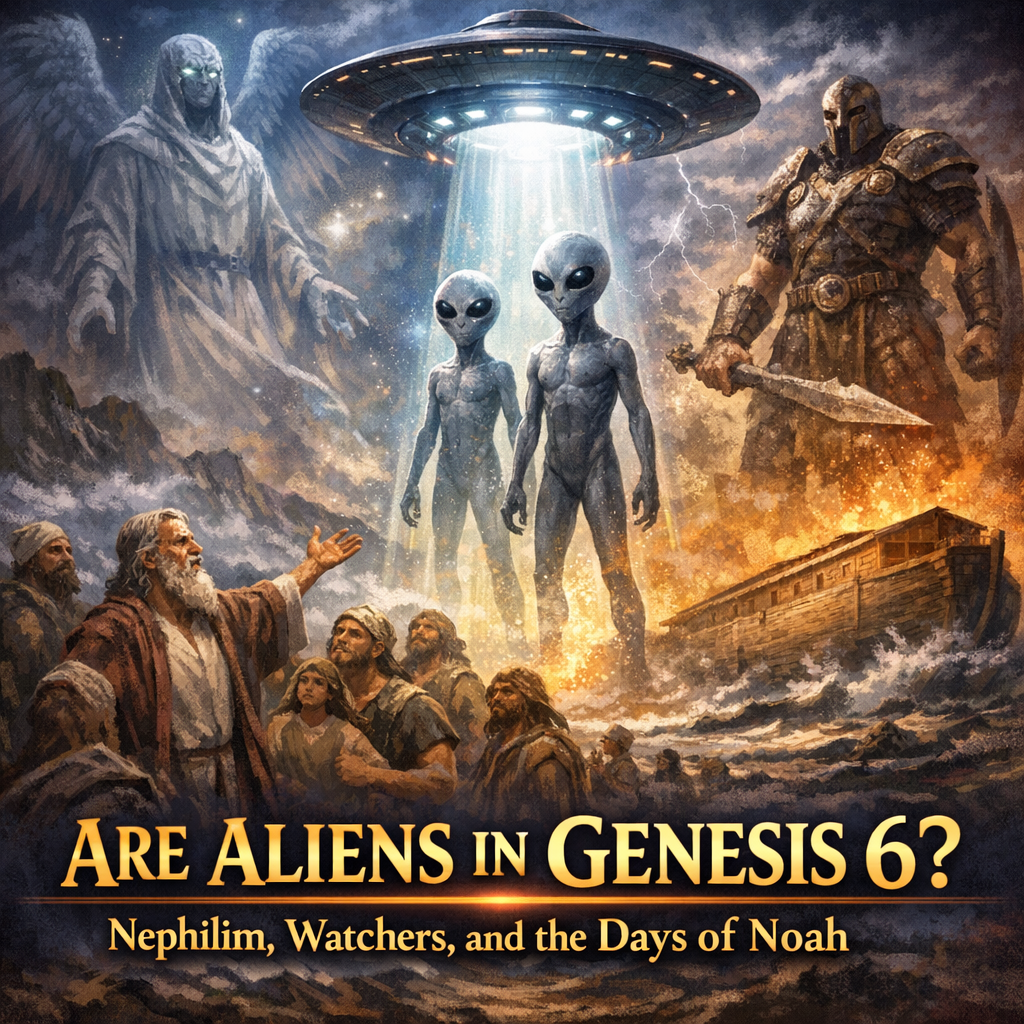
When people ask, “Are aliens in Genesis 6?” they are usually trying to connect several mysteries at once: the Nephilim, the “sons of God,” the Watchers, UFOs, ancient alien theories, and Jesus’ warning that the last days would be “as were the days of Noah” (Matthew 24:37). It is an understandable question, especially in a world of UAP disclosure hearings, strange sightings, abduction claims, and growing public curiosity about non-human intelligence. But before Christians rush to connect modern headlines to ancient texts, we need to slow down and ask the most important question first: what does Scripture actually say?
What Genesis 6 Actually Says About the Nephilim
Genesis 6:1–4 is one of the most debated passages in the Old Testament. The text says that “the sons of God” saw that the “daughters of man” were attractive and took them as wives, and that the Nephilim were on the earth in those days—and also afterward. These Nephilim are described as “mighty men who were of old, the men of renown.” Immediately after this, the passage turns to the spread of human wickedness and the judgment of the flood. Whatever else we say, Genesis 6 is not presented as a sci-fi story. It is a theological text about rebellion, corruption, judgment, and the grief of God over sin.
There are several major Christian interpretations of the “sons of God.” Some believe they were godly descendants of Seth intermarrying with the ungodly line of Cain. Others argue they were ancient kings, tyrants, or rulers taking women by force and building violent kingdoms. A third view, common in Second Temple Jewish literature and held by many early Christians, is that the “sons of God” were heavenly beings who rebelled by crossing a God-ordained boundary. This view is often connected to the Watchers in 1 Enoch, though 1 Enoch is not Scripture for most Christians. Still, passages like Job 1:6, Job 2:1, and Job 38:7 do use “sons of God” language for heavenly beings, which is why many Bible teachers take the supernatural view seriously.
So, are the Nephilim “aliens”? Genesis never calls them that. The Bible’s categories are not modern extraterrestrial categories but spiritual and theological ones: God, humans, angels, demons, principalities, powers, and rebellious heavenly beings. If Genesis 6 describes a supernatural rebellion, it is not describing visitors from another planet in the modern sense. It is describing forbidden interaction between the heavenly realm and the human realm, resulting in corruption and violence on the earth. That may sound strange to modern readers, but the biblical worldview already includes an unseen realm. The question is not whether the Bible is open to spiritual realities—it clearly is—but whether we should force modern alien language onto an ancient biblical text. We should be careful.
Watchers, UFOs, and the Days of Noah Today
The Watchers come mainly from Jewish literature like 1 Enoch, where rebellious heavenly beings descend, corrupt humanity, and produce giants. While Christians should not treat 1 Enoch as equal to Scripture, we should recognize that the New Testament appears to know this tradition. Jude 6 speaks of angels who “did not stay within their own position of authority,” and 2 Peter 2:4–5 connects sinning angels with the days of Noah. These passages do not give us every detail we might want, but they do suggest that some kind of angelic rebellion was part of the ancient biblical imagination surrounding Genesis 6. Again, Scripture gives us enough to be sober, not enough to be sensational.
This is where modern UFO and alien discussions become interesting—but also dangerous if we are not grounded. Some Christians argue that UFOs and alien abduction experiences may be demonic deceptions, perhaps connected to the same kind of spiritual rebellion hinted at in Genesis 6. Others believe UAPs may involve secret human technology, misidentified natural phenomena, psychological experiences, or a mixture of several things. A Bible-first approach does not require us to deny every strange report, nor does it require us to believe every dramatic claim. The Christian worldview has room for unseen spiritual powers, but it also calls us to test everything, avoid fear, and refuse speculation that goes beyond what is written.
When Jesus said the coming of the Son of Man would be “as were the days of Noah,” His main point was not to give a detailed prophecy about Nephilim returning or aliens appearing. In Matthew 24:37–39, the emphasis is on ordinary life continuing while people ignore coming judgment: eating, drinking, marrying, and being given in marriage until the flood came. That does not mean Genesis 6 is irrelevant to end-times discussions, but it does mean we should keep Jesus’ emphasis where He put it. The days of Noah were marked by corruption, violence, spiritual rebellion, and human indifference to God’s warning. Those themes are far more important than trying to decode every UFO headline as Bible prophecy.
Christians do not need to panic over UFOs, UAP disclosure, alien theories, or questions about the Nephilim. Scripture gives us a bigger and more stable framework than the modern imagination can offer. Genesis 6 may point to a strange and serious rebellion involving the unseen realm, but it does not invite us into fear, obsession, or wild speculation. It calls us to recognize the depth of evil, the reality of spiritual warfare, and the holiness of God. Most importantly, the story of Noah points beyond judgment to salvation—and ultimately to Jesus Christ, the true ark of refuge. Whatever is happening in the skies, in governments, or in the unseen realm, Christ is Lord over all things visible and invisible.
Related Reading
Get the Book
Go deeper with
Jared Lewis’s books on Google Play or browse the collection on
Etsy.
The Enduring Relevance of Genesis 6
Genesis 6 is not an obscure footnote in the biblical narrative—it is one of the most important passages for understanding why God judged the antediluvian world so severely and why Jesus used that era as a prophetic template for the last days. Whether one holds the divine council view, the Sethite view, or a hybrid interpretation, the core theological message is the same: human history is not merely a political or economic story. It is a cosmic conflict between the purposes of God and the rebellion of spiritual powers who seek to corrupt and destroy His creation. Christians engaging with modern UAP phenomena, transhumanist ideologies, and claims of non-human contact are not dealing with new problems. They are dealing with ancient ones. And the God who judged those ancient corruptions is the same God who promises to make all things new (Revelation 21:5).