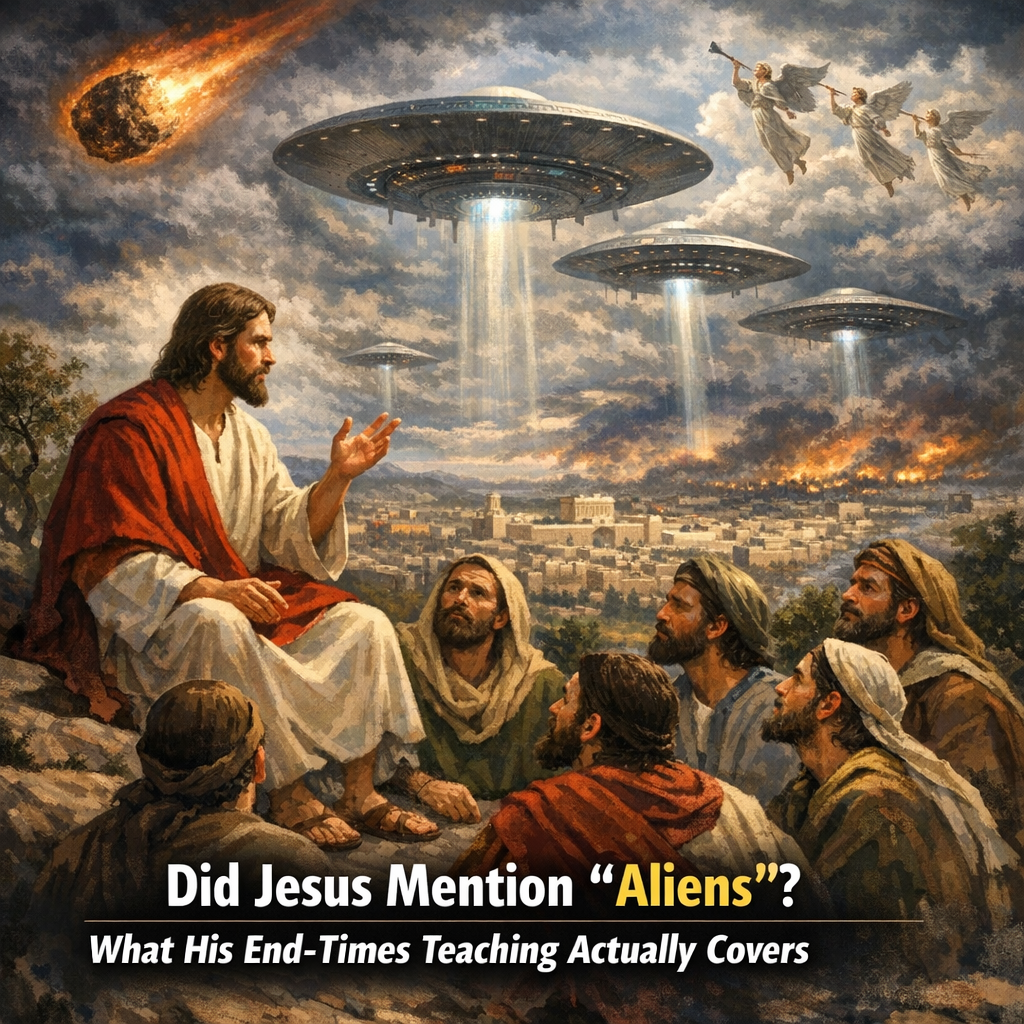
When UFOs, UAPs, “alien” encounters, and government disclosure make the news, Christians naturally ask: Does the Bible say anything about this? More specifically, some wonder whether Jesus ever warned about extraterrestrials, interdimensional beings, or end-times deception connected to the skies. Those are fair questions—but if we want a Bible-first answer, we have to begin where Scripture begins and stop where Scripture stops. Jesus spoke clearly about the last days, spiritual deception, angels, demons, judgment, and His return. But we should be careful not to force modern headlines into His words before we have listened to what He actually said.
Did Jesus Ever Mention Aliens, UFOs, or UAPs?
Jesus never directly mentioned “aliens,” UFOs, or UAPs in the modern sense. The four Gospels contain no teaching in which He describes beings from other planets, spacecraft visiting Earth, or extraterrestrial civilizations. Anyone claiming that Jesus cryptically referenced alien life in His teaching is reading those meanings into the text rather than drawing them out of it.
What Jesus did affirm is a rich and complex view of reality that goes far beyond materialist science. He spoke directly with spiritual beings, cast out demons, interacted with angels, described the activity of Satan, and referenced a cosmic conflict playing out behind the scenes of human history. He spoke of “the ruler of this world” (John 12:31), of Satan falling “like lightning from heaven” (Luke 10:18), and of angelic beings who “always see the face of my Father” (Matthew 18:10). The universe Jesus described is not populated with extraterrestrial biological life from other planets—but it is very much not empty.
What His End-Times Teaching Actually Covers
Jesus’ most extended end-times teaching appears in Matthew 24, Mark 13, and Luke 21—collectively known as the Olivet Discourse. Understanding what these passages actually say is the essential starting point for any Christian thinking about UFOs, signs in the sky, and the last days.
The first and most prominent theme in Jesus’ end-times teaching is deception. He opens His discourse in Matthew 24:4 with “See that no one leads you astray,” and this warning runs through the entire passage. In Matthew 24:24, He specifically says, “False christs and false prophets will arise and perform great signs and wonders, so as to lead astray, if possible, even the elect.” The signs He warns about are convincing, supernatural, and ultimately deceptive. This is not a description of military technology—it is a description of spiritual deception on a massive scale.
The second major theme is cosmic disruption. In Luke 21:25–26, Jesus says, “And there will be signs in sun and moon and stars, and on the earth distress of nations in perplexity because of the roaring of the sea and the waves, people fainting with fear and with foreboding of what is coming on the world. For the powers of the heavens will be shaken.” This language is drawn directly from Old Testament prophetic tradition. Isaiah 13:10, Joel 2:30–31, and Amos 8:9 all use similar imagery to describe divine intervention in history and the approach of the Day of the Lord. It is not a description of unusual lights in the sky during normal times—it describes the cosmic unraveling that accompanies the return of Christ.
The third theme—the one Jesus spends the most time on—is readiness for His return. The Olivet Discourse ends not with a dramatic chart of aerial phenomena but with a series of parables about waiting, working, and being prepared for the return of the Master (Matthew 24:45–25:46). The call is to faithfulness, not to decoding UAP videos.
What Jesus Said About Spiritual Deception and Why It Matters Now
The most relevant aspect of Jesus’ end-times teaching for the current UAP conversation is His repeated and serious warning about deception. He did not say “watch the skies for signs.” He said “watch out that no one deceives you.” The emphasis is on spiritual discernment, not aerial observation.
This is significant because the dominant narratives surrounding UAP disclosure often carry spiritual content. Contactee reports describe beings that deliver messages about humanity’s evolution, the elimination of religious exclusivity, and new paths to enlightenment. These messages directly contradict what Jesus taught. He said “I am the way, and the truth, and the life. No one comes to the Father except through me” (John 14:6). Any message—from any source—that undermines that claim should be evaluated with serious caution.
How Christians Should Respond
Jesus’ end-times teaching does not give us a detailed explanation of UAP phenomena. But it does give us exactly what we need to navigate the conversation faithfully:
- Discernment over speculation. Jesus modeled careful, Scripture-grounded thinking. Christians should evaluate UAP claims against what He actually taught, not against what would make for an interesting prophecy connection.
- Alertness without anxiety. Jesus warned His followers to be alert (Matthew 24:42), but He also said “do not be troubled” (Matthew 24:6). Anxiety about UAP disclosure is not the fruit of Jesus’ teaching. Calm, watchful faithfulness is.
- Christ as the center. Jesus made His own return the centerpiece of end-times hope. Any framework that replaces or diminishes that hope—whether through alien mythology or speculative eschatology—has missed His teaching entirely.
Conclusion
Jesus did not mention aliens—but He did say everything we need to know about how to think when the world gets strange. His end-times teaching is a call to discernment, faithfulness, and hope centered on His return. Whether modern “alien” narratives are psychological, technological, or spiritual in origin, the believer’s anchor remains the same: Jesus is Lord, Scripture is the authority, and the Gospel is the message the world needs more than any disclosure event could provide.
The Practical Takeaway: What Should Christians Watch For?
Jesus’ end-times teaching gives believers very practical things to watch for—and they are not government disclosure events or alien contact announcements. He told His followers to watch for false messiahs (Matthew 24:5), wars and rumors of wars (Matthew 24:6), persecution of believers (Matthew 24:9–10), the spread of the Gospel to all nations (Matthew 24:14), and the abomination of desolation (Matthew 24:15). He told them to watch their own hearts against fear, distraction, and the cares of this life that can dull spiritual alertness (Luke 21:34–36). None of this requires decoding UAP disclosure. What it requires is a life rooted in Scripture, prayer, and faithful obedience. Christians who are doing those things will not be caught off guard by whatever end-times events unfold—because their confidence is not in their ability to predict the future, but in the God who already holds it.