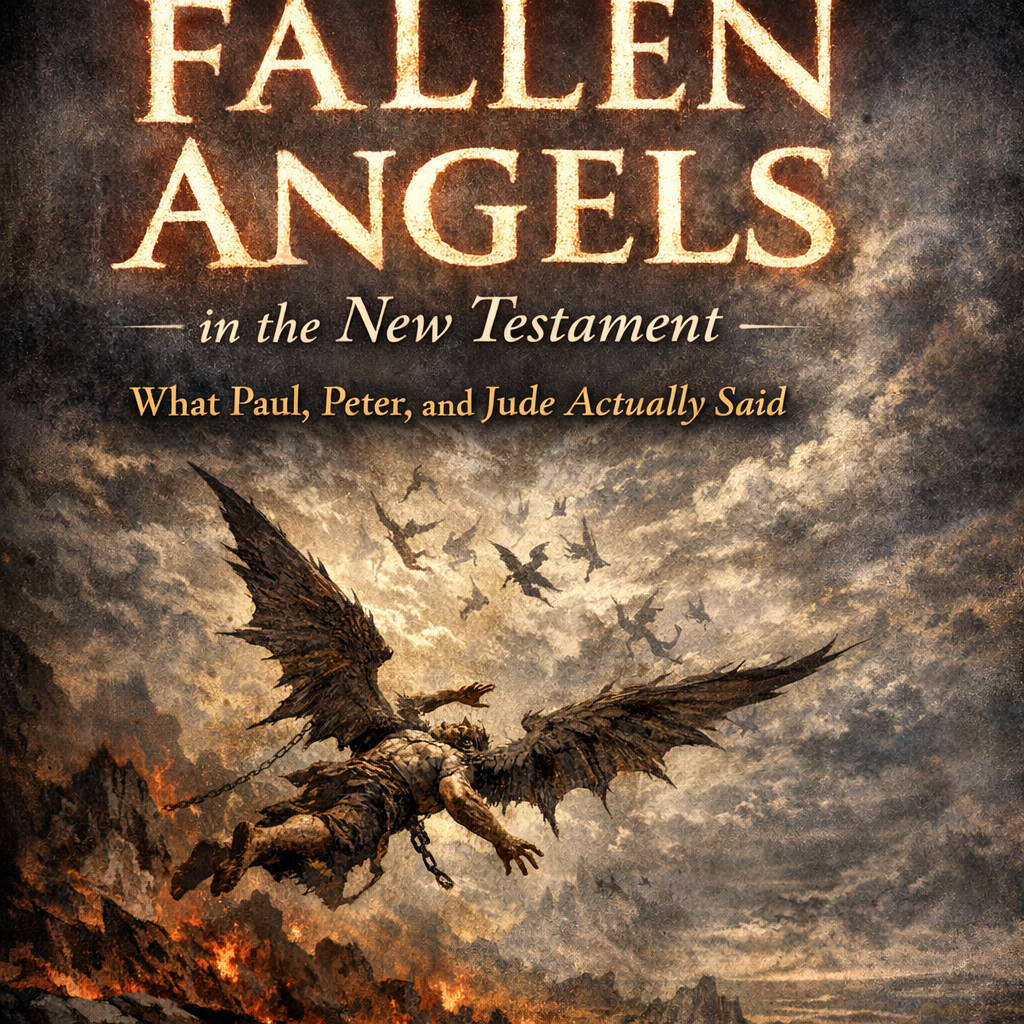
Most Christians are familiar with the story of fallen angels in a general sense — that Satan and his angels rebelled against God and were cast out of heaven. But the New Testament contains a far more specific and theologically rich set of references to fallen divine beings than most readers realize. Paul, Peter, and Jude each engage with a tradition of cosmic rebellion that goes back to the Book of Enoch and the pre-Flood world. What they say is both surprising and profoundly significant for understanding the nature of spiritual warfare and the victory of Christ.
Jude: The Most Explicit Reference
The letter of Jude is arguably the most explicit engagement with Enochian traditions in the entire New Testament. In verse 6, Jude writes about “angels who did not keep their proper domain, but left their own abode.” He says these angels are kept “in everlasting chains under darkness for the judgment of the great day.” In verse 7, he compares their sin to the sexual immorality of Sodom and Gomorrah — explicitly connecting their transgression to “going after strange flesh.”
This is a direct reference to the Watchers of Genesis 6 and the Book of Enoch — divine beings who abandoned their proper station to take human women. Jude then quotes the Book of Enoch directly in verses 14-15, treating it as prophetic Scripture. This is not casual allusion — Jude treats the Enochian tradition as historically accurate and authoritative.
Peter: Angels in Chains
Second Peter 2:4 contains one of the most striking statements in the New Testament: “For if God did not spare angels when they sinned, but cast them into Tartarus and committed them to chains of gloomy darkness to be kept until the judgment…” The word translated “cast into Tartarus” is remarkable — tartaroō, a verb derived from “Tartarus,” the deepest pit of the underworld in Greek mythology, where divine rebels were imprisoned.
Peter uses this language deliberately, drawing on both Greek cosmological tradition and the Jewish Enochian tradition to describe the prison of the rebellious Watchers. He goes on to cite the Flood as the next example of divine judgment — cementing the connection between the imprisoned angels and the pre-Flood rebellion of Genesis 6.
Paul: Principalities, Powers, and the Cosmic Hierarchy
Paul’s letters are filled with references to a complex supernatural hierarchy operating in the world. In Ephesians 6:12, he writes that the believer’s struggle is not against flesh and blood but “against the rulers, against the authorities, against the cosmic powers over this present darkness, against the spiritual forces of evil in the heavenly places.” This language draws on the Jewish concept of divine beings assigned to govern nations — beings who have rebelled and now operate as forces of darkness.
In Colossians 2:15, Paul describes Christ’s crucifixion as a triumphant disarmament of “the rulers and authorities” — divine rebels who had enslaved humanity. In 1 Corinthians 15:24, he speaks of Christ reigning “until he has put all his enemies under his feet,” including every “rule and authority and power.” The cosmic scope of Christ’s victory in Paul’s theology only makes full sense against the backdrop of the Enochian tradition of divine rebellion.
First Peter 3:18-20 and the Imprisoned Spirits
One of the most discussed and debated passages in the New Testament is 1 Peter 3:18-20, where Peter writes that Christ, after his death, “went and proclaimed to the spirits in prison, who formerly did not obey, when God’s patience waited in the days of Noah.” The identity of these “spirits” has been debated for centuries, but the context strongly suggests they are the imprisoned Watchers — the fallen divine beings whose sin precipitated the Flood.
If this interpretation is correct, Christ’s proclamation to the imprisoned Watchers was a declaration of victory — an announcement that his death and resurrection had definitively triumphed over the rebellion that began at Mount Hermon. The cosmic war was over. The enemy had been defeated. The announcement needed to be made even to those imprisoned at the bottom of the divine hierarchy.
The New Testament Vision of Cosmic Redemption
Reading the New Testament with awareness of the Enochian background reveals a stunning vision of cosmic redemption. The incarnation, death, and resurrection of Christ were not merely transactions for human salvation — they were victories in a cosmic war that has been raging since before the Flood. Every reference to “principalities and powers,” every mention of angels in chains, every proclamation of Christ’s supremacy over spiritual forces — all of it belongs to a vast cosmic narrative that Scripture traces from the garden of Eden to the new creation.
Watch the Full Video on YouTube
Get the Ebook
Jared Lewis’s ebook takes you through the full biblical narrative of fallen angels, the Watchers, and the cosmic victory of Christ. Get your copy today.
Follow Jared Lewis
- 📺 YouTube: @JaredLewisBooks
- 📸 Instagram: @JaredLewisBooks
- 🧵 Threads: @JaredLewisBooks
- 🐦 X (Twitter): @JaredLewisBooks
Go Deeper: Related Articles
Paul, Peter, and Jude wrote about fallen angels because they understood the Old Testament background. That background begins with the rebellion described in Genesis 6. For the full exegetical account, see who the sons of God in Genesis 6 actually were.
One critical question their letters raise is the difference between fallen angels and demons. These are not identical categories in Scripture. Explore the distinction in our post on fallen angels vs. demons: what’s the difference?
The institutional context for the angelic rebellion—the divine council that these beings defected from—is explained in our post on the Divine Council and God’s heavenly government.
And for how these ancient texts were preserved and what the Dead Sea Scrolls add to our understanding of the Watchers and fallen beings, read what the Dead Sea Scrolls and the Book of Enoch reveal.
For a look at the hybrid offspring of the fallen Watchers and human women, see Aliens, Nephilim, and Hybrid Beings: How Far Does Scripture Really Go?
Why the New Testament’s Teaching on Fallen Angels Still Matters
The New Testament’s teaching on fallen angels is not a relic of ancient cosmology that modern Christians can safely ignore. It is a live and relevant framework for understanding the spiritual landscape of the present age. Paul’s language about principalities, powers, and rulers in the heavenly places (Ephesians 6:12) gives the Christian a sober-minded picture of why the world resists the Gospel, why evil seems systemic and not merely individual, and why spiritual warfare requires more than human effort. Peter’s and Jude’s references to the imprisoned angels (2 Peter 2:4; Jude 6) remind the church that God’s justice is certain—even when it is deferred. No spiritual power, however ancient or entrenched, is beyond His reach or immune to His judgment. For believers navigating a world full of competing spiritual claims—including modern interest in UAPs, non-human intelligences, and angelic beings—the New Testament provides exactly the authoritative framework needed: a world in which unseen spiritual forces are real, defeated in principle by the cross, and destined for final judgment at the return of Christ.