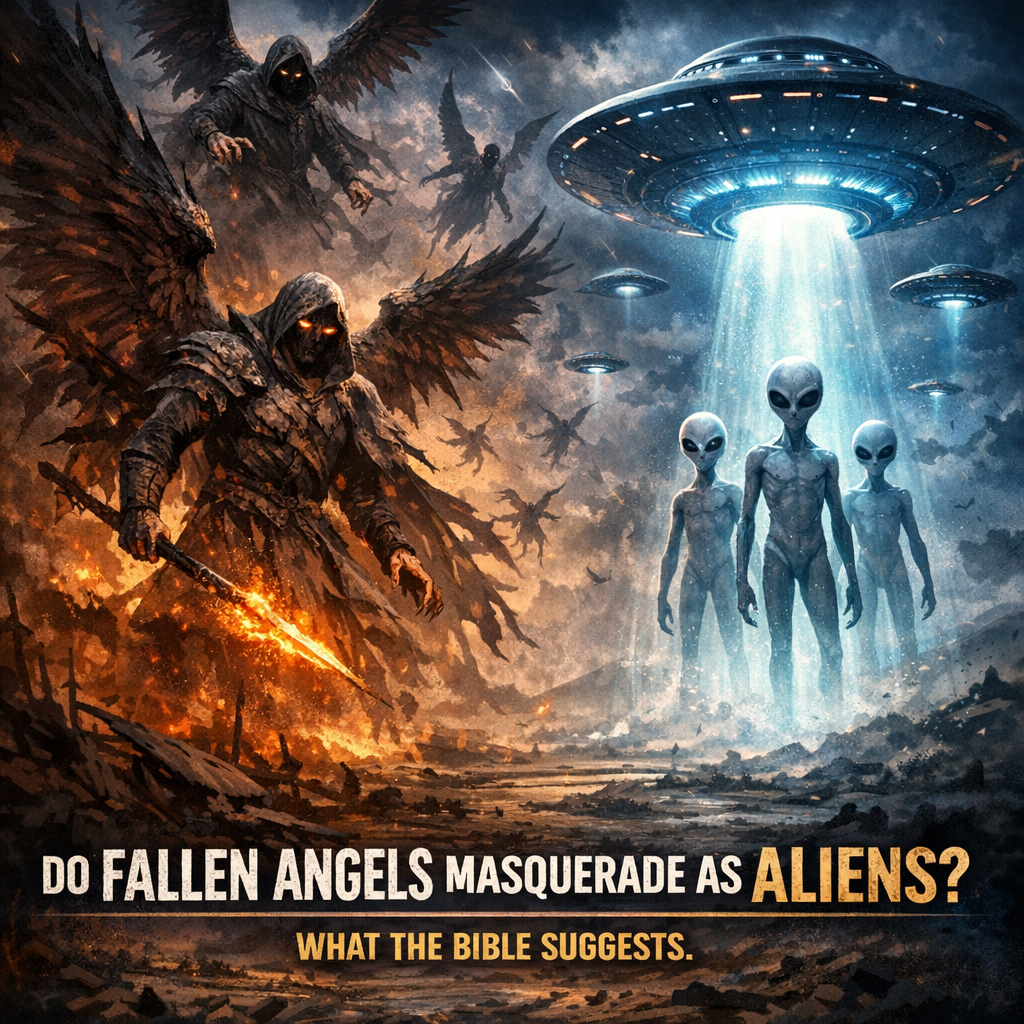
UFOs, aliens, UAP disclosure, and abduction stories are no longer confined to late-night radio shows and fringe documentaries. They show up in congressional hearings, news headlines, podcasts, and everyday conversations. For Christians who take the Bible seriously, the question is not simply, “Are UFOs real?” but, “How should we think about these claims under the authority of Scripture?”
One of the most provocative theories circulating in both Christian and secular spaces is this: what if the beings described in alien encounters are not extraterrestrials from distant planets, but fallen spiritual beings—angels who rebelled against God and now operate in deception? It sounds dramatic, but it is grounded in a serious reading of Scripture. This article examines what the Bible actually teaches about fallen angels, their capacity for deception, and whether the alien phenomenon could be understood within a biblical framework.
What the Bible Says About Fallen Angels
The Bible is clear that spiritual beings exist who have rebelled against God. In Genesis 6:1–4, we read about the “sons of God” who came down and interacted with humanity in ways that corrupted the earth and led to the Flood. The Book of Jude (v. 6) and 2 Peter 2:4 both reference angels who “did not keep their own domain” and were imprisoned as a result. These texts establish that there is a category of fallen spiritual beings who stepped outside their God-ordained boundaries and interacted with the physical world in unauthorized ways.
Paul’s letters describe a hierarchy of spiritual powers in rebellion against God. In Ephesians 6:12, he writes that believers wrestle “against the rulers, against the authorities, against the cosmic powers over this present darkness, against the spiritual forces of evil in the heavenly places.” These are not vague metaphors. Paul is describing an organized spiritual opposition with rank, authority, and the ability to operate in the unseen realm that intersects with the visible world.
Satan as the Master of Disguise
One of the most directly relevant passages for this topic is 2 Corinthians 11:14, where Paul writes: “And no wonder, for even Satan disguises himself as an angel of light.” This is a stunning statement. The chief of fallen spiritual beings is described as capable of presenting himself in a form that appears holy, luminous, and trustworthy. If Satan himself can do this, it is reasonable to infer that beings under his authority possess similar capacity for disguise and deception.
This is not speculation—it is a theological principle the Bible establishes directly. The purpose of the disguise is deception. In 2 Thessalonians 2:9–10, Paul describes the coming “lawless one” whose arrival is “by the activity of Satan with all power and false signs and wonders, and with all wicked deception for those who are perishing.” The end-times framework Paul presents includes supernatural signs that are false, but convincing enough to deceive those who do not hold to the truth of Scripture.
Alien Encounters Through a Biblical Lens
Many researchers who study UFO and alien contact reports note a number of recurring features: encounters often involve beings that appear luminous or otherworldly, messages received during encounters tend to undermine the uniqueness of Christ or offer alternative paths to enlightenment, and the experiences themselves can produce lasting spiritual disorientation in those who have them. These features are not proof that fallen angels are behind every UAP sighting, but they do align with the kind of deceptive spiritual activity the Bible describes.
Researcher and former MUFON director Jacques Vallée—not a Christian apologist—concluded after decades of studying abduction reports that the phenomenon behaves more like a spiritual or interdimensional reality than a visitation from a physically distant star system. The beings seem to operate outside normal physical laws, communicate telepathically, and pursue psychological and spiritual transformation of those they contact. These are characteristics the Bible would associate with spiritual beings, not biological creatures from another planet.
The Messages Don’t Align With Scripture
Perhaps the most theologically significant test for any encounter is the content of the messages delivered. Across thousands of documented contact reports, the beings consistently deliver messages that include: humanity is not alone and has been visited for millennia, there is no exclusive path to truth or salvation, organized religion (especially Christianity) is a control system, and the visitors are here to guide humanity to the next stage of evolution. Every one of these messages directly contradicts the teaching of Scripture.
The Bible does not teach that humanity has secret cosmic neighbors who have been watching us. It teaches that God created all things, that humanity fell in Adam, that Christ is the only way to reconciliation with God (John 14:6), and that the age will end with the return of Christ in judgment. Any spiritual message that contradicts these foundations should be evaluated with extreme caution. First John 4:1 instructs: “Beloved, do not believe every spirit, but test the spirits to see whether they are from God.”
How Should Christians Respond?
The biblical framework does not require Christians to have an answer for every UAP video or abduction report. What it does require is a solid foundation in Scripture that allows for discernment. Here are several principles that guide a biblically faithful response:
- Test every message against Scripture. If a spiritual being—however it presents itself—delivers a message that undermines the authority of Christ, the truthfulness of Scripture, or the exclusivity of the Gospel, it fails the biblical test regardless of how impressive the encounter was.
- Do not be consumed by fear or obsession. The Bible calls believers to sobriety and watchfulness (1 Peter 5:8), not to panic or endless speculation. Engaging this topic should produce greater confidence in Scripture and greater trust in God, not anxiety.
- Maintain humility about specific claims. Saying “fallen angels could be behind some of this” is different from saying “every UAP is a demon.” The Bible gives us a framework for discernment, not a complete explanation of every phenomenon in the sky.
- Ground your worldview in the resurrection of Christ. If Christ has risen and all authority in heaven and earth has been given to Him (Matthew 28:18), then no fallen spiritual being operates outside His ultimate sovereignty. This is the most stabilizing truth a Christian can hold when engaging these questions.
Conclusion
The question of whether fallen angels could masquerade as aliens is not a fringe theological curiosity. It is a serious question that follows naturally from what Scripture teaches about spiritual deception, the nature of fallen beings, and the end-times context in which we live. The Bible does not give us a verse that says “aliens are demons,” but it does give us everything we need to evaluate spiritual claims: a high view of Scripture, the person and work of Christ as the measuring rod, and the Holy Spirit as the guide into all truth.
As UAP disclosure continues and these questions become more pressing in public conversation, Christians have a remarkable opportunity. Rather than retreating into either dismissal or sensationalism, believers can engage thoughtfully, point to the biblical framework for understanding the unseen realm, and demonstrate that the Gospel has always known the universe is bigger than what our eyes can see.