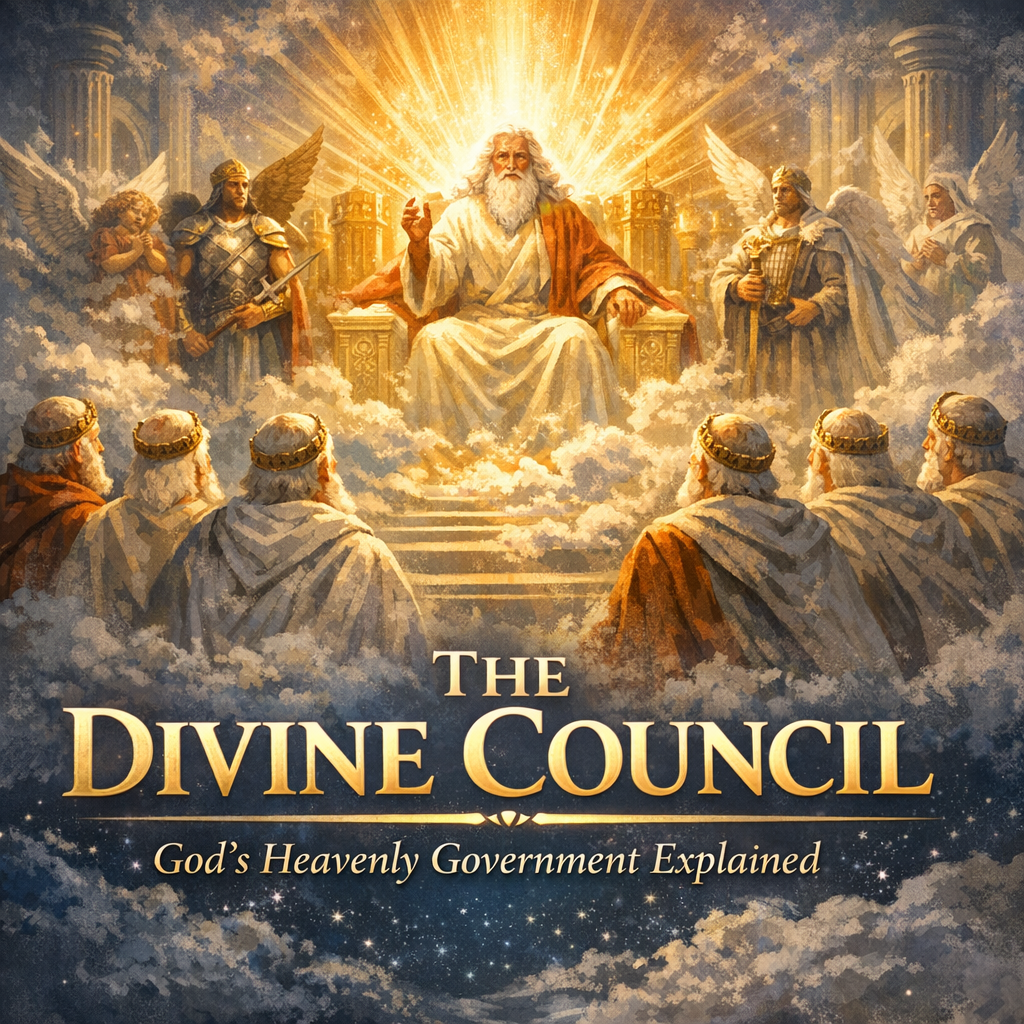
Most people picture heaven as a place of clouds, angels, and harps. But the Bible presents something far more structured and dramatic: a cosmic government — a divine council in which God rules over a complex hierarchy of supernatural beings who carry out his purposes across the created order. Understanding the divine council is essential for making sense of the spiritual warfare described throughout both the Old and New Testaments.
What Is the Divine Council?
The divine council is the heavenly assembly of divine beings who surround God and participate in his governance of the universe. This concept appears throughout the Old Testament. In 1 Kings 22:19, the prophet Micaiah sees God sitting on his throne with “all the host of heaven standing beside him on his right hand and on his left.” In Job 1-2, the “sons of God” present themselves before God and engage in dialogue with him. In Psalm 82, God stands in “the divine assembly” and renders judgment against the divine beings who have misruled the nations.
These are not angels in the Sunday-school sense. They are members of God’s heavenly court — beings of real authority and power, who have genuine roles in governing creation. The Bible takes their existence for granted, much as any ancient Near Eastern reader would have. The divine council was a common concept across the ancient world, and the biblical writers engaged with it on those terms while insisting on the unique supremacy of Israel’s God.
The Sons of God and the Nations
Deuteronomy 32:8-9 contains one of the most remarkable passages in the entire Old Testament. The Hebrew text (confirmed by the Dead Sea Scrolls) reads: “When the Most High gave to the nations their inheritance, when he divided mankind, he fixed the borders of the peoples according to the number of the sons of God. But the Lord’s portion is his people, Jacob his allotted heritage.”
This text describes a specific moment — the division of the nations at Babel — when God assigned different nations to different divine beings. Israel alone was kept as God’s own inheritance. This is a worldview-shaping passage: it means that the “gods” of the nations were not mere idols or human inventions. They were real supernatural beings, members of God’s council, who had been given authority over the nations and who later corrupted that authority through rebellion.
Psalm 82: The Judgment of the Divine Council
Psalm 82 is one of the most theologically dense chapters in the entire Bible. It opens: “God has taken his place in the divine assembly; in the midst of the gods he holds judgment.” God proceeds to indict these divine beings for their failure to administer justice, protect the poor and vulnerable, and maintain the righteous order he established. The psalm concludes with God pronouncing their death sentence: “You are gods, sons of the Most High, all of you; nevertheless, like men you shall die.”
Jesus quotes this psalm in John 10:34, applying it in the context of his own divine identity. The divine council of Psalm 82 forms the backdrop for the entire New Testament’s discussion of “principalities and powers” — rebellious members of God’s heavenly government who have become the spiritual rulers of the fallen world order.
The Divine Council and the Tower of Babel
Genesis 11 records the construction of the Tower of Babel and God’s judgment on the project. What is less commonly noted is that Genesis 11 functions as the backdrop for Deuteronomy 32:8-9. When God “confused” the languages at Babel and “dispersed” the nations, he simultaneously assigned each nation to the governance of a divine being. This is the moment when the nations were placed under the oversight of the “sons of God” — and also the moment when God chose to work specifically through Abraham’s family as the vehicle for his redemptive purposes.
Christ’s Victory Over the Divine Council Rebels
The New Testament announces that Christ has definitively defeated the rebellious members of the divine council. Colossians 1:16 declares that all things were created “in heaven and on earth, visible and invisible, whether thrones or dominions or rulers or authorities — all things were created through him and for him.” Philippians 2:10 announces that at the name of Jesus, every knee will bow — “in heaven and on earth and under the earth.” This language encompasses the entire divine hierarchy, including the rebellious members who now await final judgment.
The divine council framework helps modern readers understand what the New Testament writers actually meant when they spoke of spiritual warfare, angelic beings, and the powers of darkness. It was not vague metaphor — it was a precise theological framework rooted in the Old Testament understanding of how the cosmos is governed, and how Christ’s victory has transformed that governance forever.
Watch the Full Video on YouTube
Get the Ebook
Jared Lewis’s ebook explores the divine council, the sons of God, the Nephilim, and the cosmic framework that makes the entire Bible click into place.
Follow Jared Lewis
- 📺 YouTube: @JaredLewisBooks
- 📸 Instagram: @JaredLewisBooks
- 🧵 Threads: @JaredLewisBooks
- 🐦 X (Twitter): @JaredLewisBooks
Related Reading on the Divine Council and the Unseen Realm
The Divine Council is not an isolated concept—it is the framework that explains much of the cosmic conflict running through Scripture. The rebellion of some council members in Genesis 6 is the direct backstory to the Nephilim. Read the full account in our pillar post on the complete story of the Nephilim from Genesis to Revelation.
One of the most dramatic expressions of divine council judgment in Scripture is Psalm 82, which describes God pronouncing sentence on corrupt divine rulers. This directly connects to the cosmic war announced in Genesis 3 and still being prosecuted through human history.
The site of Mount Hermon has a special significance in the divine council tradition as the location where rebellious heavenly beings crossed a cosmic boundary. Explore the evidence in our post on Mount Hermon and the divine rebellion.
And for what the New Testament apostles taught about fallen divine beings still operating in the present age, read what Paul, Peter, and Jude actually said about fallen angels.
The Watcher offspring—Nephilim and hybrid beings—are examined in our post on Aliens, Nephilim, and Hybrid Beings: How Far Does Scripture Really Go?