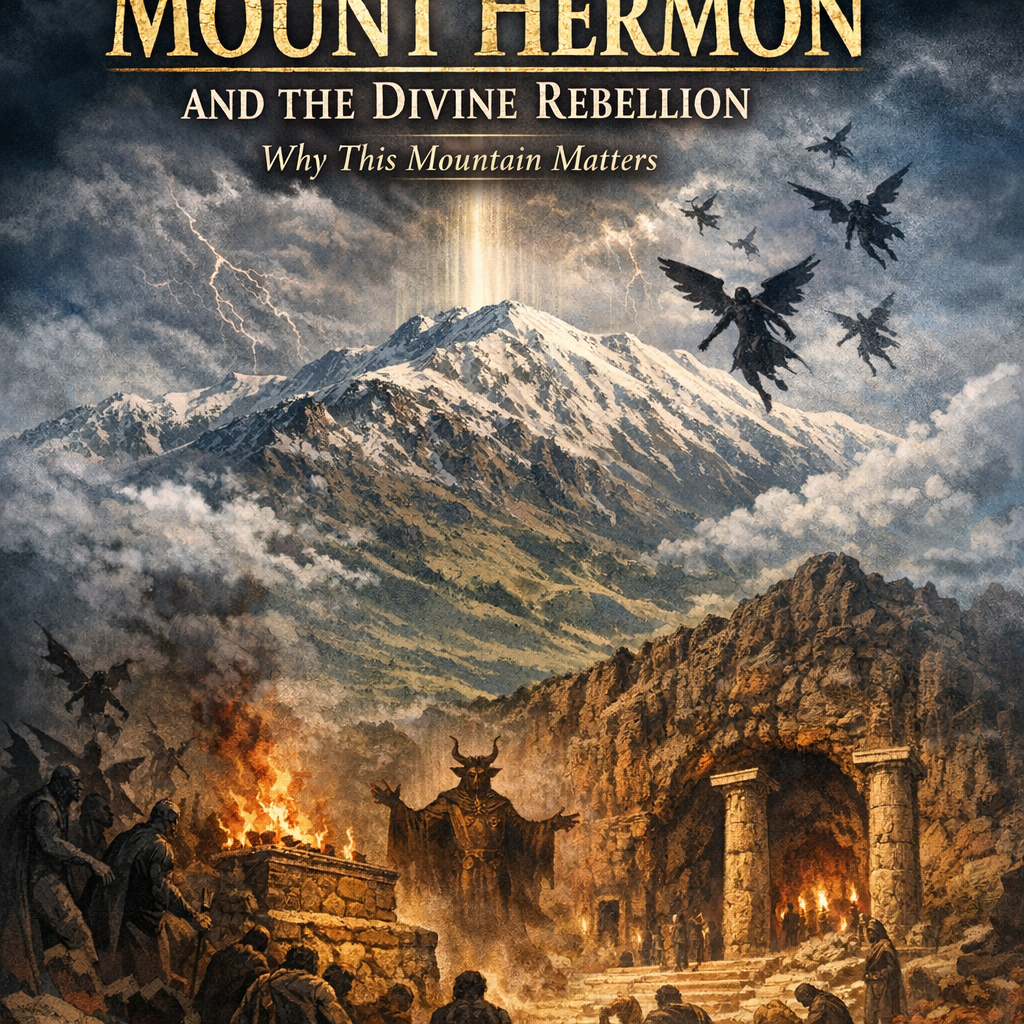
In the ancient world, mountains were not merely geological features — they were considered the dwelling places of gods. And of all the mountains in the biblical world, none carries more theological weight than Mount Hermon. Standing at over 9,000 feet at the northern border of ancient Israel, Hermon is the site where, according to the Book of Enoch, the Watchers descended to earth and sealed their rebellion against God. Understanding Mount Hermon is essential to understanding the cosmic war that runs through the entire Bible.
Mount Hermon in the Book of Enoch
The Book of Enoch records that 200 Watchers — divine beings assigned to watch over humanity — gathered on the summit of Mount Hermon and swore a mutual oath to descend together and take human women as wives. The name “Hermon” itself is connected to the Hebrew root herem, meaning a sacred ban or devoted thing — something set apart, often for destruction. The very name of the mountain encodes the nature of the oath sworn there.
This was not a spontaneous act of desire. It was a coordinated rebellion — a deliberate crossing of the boundary God had established between the divine and human realms. By taking the oath on Hermon, the Watchers ensured they would collectively face the same judgment. There was no individual escape. The rebellion was total.
Mount Hermon in the Old Testament
Mount Hermon appears repeatedly in the Old Testament as a significant geographical and theological landmark. It marks the northern boundary of the land conquered by Moses and Joshua (Deuteronomy 3:8, Joshua 12:1). It is associated with the territory of Bashan — the kingdom ruled by Og, the last of the Rephaim giants, whose defeat is celebrated throughout Israelite history.
The region of Bashan carries its own sinister resonance. The word “Bashan” itself is related to a Semitic root connected to serpents — a fact that did not escape the attention of ancient readers. The Psalm of Ascents in Psalm 68:15-22 describes God conquering the mountain of Bashan and leading captives in his train — a passage widely interpreted as a celebration of divine victory over the rebellious powers associated with the region.
The Transfiguration: Reversing the Rebellion
One of the most theologically charged connections involving Mount Hermon is its association with the Transfiguration of Jesus. Matthew 16:13 places Jesus at Caesarea Philippi — located at the foot of Mount Hermon — when Peter confesses him as the Messiah. Jesus then announces that he will build his church and that the “gates of Hades” will not prevail against it.
The very next passage describes the Transfiguration, which most scholars believe took place on a “high mountain nearby” — almost certainly Mount Hermon itself. At the very location where the Watchers had descended in rebellion, Jesus is revealed in glory, with Moses and Elijah appearing beside him. The divine rebellion staged at Hermon is answered by a divine declaration of victory at the same location.
The Gates of Hades and the Territory of the Enemy
Caesarea Philippi was not merely a Roman city — it was the site of a pagan shrine to the god Pan, built over a cave that was believed to be the entrance to the underworld. First-century Jews would have recognized this as a place associated with death and the realm of the dead. When Jesus declared that the gates of Hades would not prevail against his church, he was speaking directly into the face of the cosmic enemy — at the very mountain where that enemy had launched his most audacious rebellion against God’s order.
Why Mount Hermon Matters for Biblical Prophecy
The geography of the Bible is not incidental. The specific locations where key events unfold are chosen with theological precision. Mount Hermon stands as a monument to divine rebellion — and to divine victory over that rebellion. From the descent of the Watchers to the Transfiguration of the Son of God, this mountain marks the battlefield where heaven and earth have clashed in the most dramatic ways.
Understanding Mount Hermon and its significance unlocks dozens of otherwise puzzling biblical passages — from the conquest narratives in Joshua to the imagery of Daniel, from the geography of Jesus’s ministry to the eschatological battles of Revelation. The mountain that witnessed the original divine rebellion will also witness its final defeat.
Watch the Full Video on YouTube
Get the Ebook
Jared Lewis’s ebook explores Mount Hermon, the Watchers, the Nephilim, and the full scope of the cosmic conflict revealed in Scripture. Don’t miss this deep dive.
Follow Jared Lewis
- 📺 YouTube: @JaredLewisBooks
- 📸 Instagram: @JaredLewisBooks
- 🧵 Threads: @JaredLewisBooks
- 🐦 X (Twitter): @JaredLewisBooks
Related Reading: The Watchers, Giants, and the Cosmic Rebellion
Mount Hermon is inseparable from the story of the Watchers and their rebellion. For the complete biblical narrative of what happened and its lasting consequences, see our cornerstone post on the complete story of the Nephilim from Genesis to Revelation.
The identity of the heavenly beings who gathered at Hermon is rooted in the divine council tradition. Read the full explanation in our post on the Divine Council and God’s heavenly government.
Enoch’s prophecy was directly addressed to the Watchers who descended at sites like Hermon. The ancient text and its predictions are examined in Enoch’s prophecy and the judgment of the Watchers.
The giants that resulted from the Watcher rebellion survived the flood in various forms and became the Anakim and Rephaim Israel faced in Canaan. See the full account in giants in the Bible: the Nephilim, Anakim, and Rephaim explained.
What Mount Hermon Teaches Us About God’s Sovereign Response to Rebellion
The significance of Mount Hermon is ultimately not about the mountain itself—it is about what the mountain reveals about God. When the Watchers descended at Hermon and introduced corruption into the human world, God did not abandon His purposes. He judged the rebels (2 Peter 2:4; Jude 6), cleansed the earth through the flood, and began the long redemptive process that would lead to the incarnation of His Son. When Israel later encountered the Anakim and Rephaim in the region associated with Hermon, God drove those remnants out through the conquests of Joshua and the judges. And when Jesus stood on the mountain near Hermon at Caesarea Philippi and declared that the gates of Hades would not prevail against His church (Matthew 16:18), He was making a direct counter-declaration against the very site of the Watcher rebellion. The God who judged at Hermon is the same God who wins at Hermon—and that victory belongs to everyone who is united to Jesus Christ by faith.