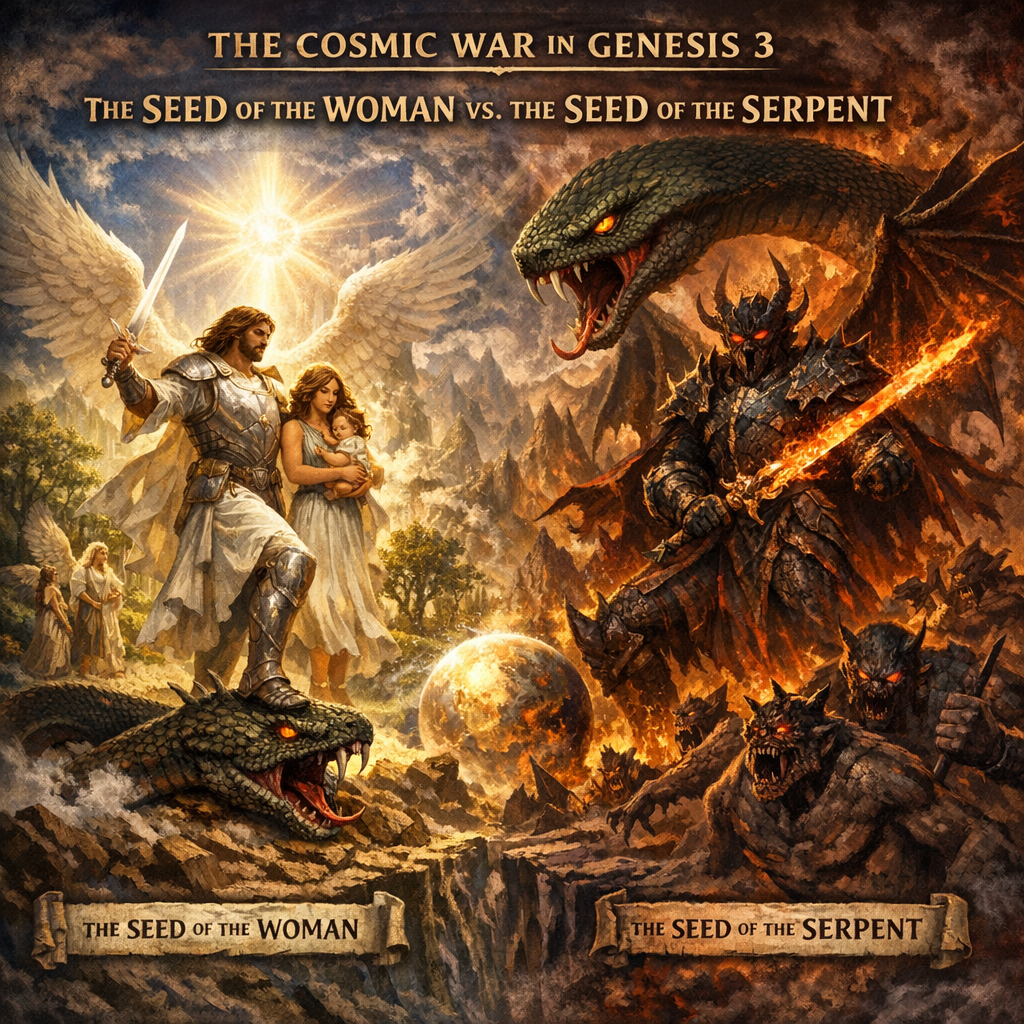
Genesis 3:15 is often called the protoevangelium — the first gospel. It contains the very first promise of redemption in all of Scripture. But it is also something else entirely: a declaration of cosmic war. When God declares that there will be enmity between the serpent and the woman, and between the serpent’s seed and the woman’s seed, he is not merely speaking of individual conflict. He is announcing a war that will run through the entire arc of biblical history — from the garden of Eden to the book of Revelation.
What Is the Protoevangelium?
In Genesis 3:15, God addresses the serpent: “I will put enmity between you and the woman, and between your offspring and her offspring; he shall bruise your head, and you shall bruise his heel.” This verse contains the first messianic prophecy in the Bible — the promise that the seed of the woman would ultimately defeat the serpent. But to understand its full significance, we need to understand what “seed” means in this context.
The Hebrew word zera (seed) can refer to a single descendant or to a collective lineage. In Genesis 3:15, it functions on both levels. There is a corporate seed of the woman (humanity in covenant with God) and a singular Seed (the Messiah). There is a corporate seed of the serpent (those aligned with the cosmic rebel) and a singular embodiment of that rebellion. The war between these two seeds is the hidden plot running beneath the surface of the entire Old Testament.
The Identity of the Serpent
The serpent of Genesis 3 is not merely a talking snake. The New Testament is explicit: Revelation 12:9 identifies “that ancient serpent” as “the devil and Satan, who deceives the whole world.” The serpent is a supernatural being — one of the members of God’s divine council who chose to rebel. The Book of Enoch and other ancient texts flesh out the backstory of this rebellion, placing it in the context of a cosmic challenge to God’s authority over creation.
The serpent’s goal in the garden was not simply to make humanity disobey God. It was to corrupt the human race in a way that would prevent the promised Seed from ever arriving. If the woman’s lineage could be sufficiently corrupted — spiritually, morally, or even genetically — the promise of Genesis 3:15 could be thwarted. This is the hidden logic behind the events of Genesis 6 and behind many of the conflicts that follow throughout the Old Testament.
The Seed War Through the Old Testament
Once you understand Genesis 3:15 as the announcement of a seed war, the narrative of the Old Testament comes into sharper focus. The murder of Abel by Cain was an early attack on the covenant lineage. The corruption of humanity through the Watchers in Genesis 6 was a more systematic attempt to contaminate the human bloodline. The destruction of the Anakim and Rephaim in the conquest of Canaan was Israel’s participation in the divine campaign to clear the promised land of supernatural corruption.
Even specific narrative moments take on new meaning. When Pharaoh ordered the death of all Hebrew male infants in Exodus 1, he was — unwittingly or otherwise — participating in the seed war. When Haman plotted the genocide of the Jewish people in Esther, he was continuing that ancient campaign. In each case, the cosmic enemy was attempting to destroy the lineage through which the Messiah would come.
The Incarnation as the Decisive Blow
The birth of Jesus Christ represents the seed of the woman entering the world in the most decisive way possible. The incarnation — God becoming human through the womb of Mary — was the serpent’s worst nightmare. The one who would crush the serpent’s head had finally arrived. Revelation 12 depicts this moment in cosmic terms: a great dragon (the ancient serpent) waits to devour the child as soon as he is born, but the child is caught up to God and his throne. Every attempt to destroy the Seed — Herod’s slaughter of the innocents, the crucifixion itself — ultimately served the purposes of God rather than thwarting them.
Genesis 3:15 and the Final Victory
The seed war does not end with the resurrection of Christ. It continues until the final judgment, when the God of peace will “crush Satan under your feet” (Romans 16:20 — a deliberate echo of Genesis 3:15). The book of Revelation describes the ultimate resolution: the ancient serpent is bound, cast into the lake of fire, and the new creation begins. The enmity announced in the garden is finally, permanently, resolved.
Genesis 3:15 is not merely a historical footnote. It is the thesis statement of the entire Bible. Everything that follows — the patriarchs, the exodus, the conquest, the kings, the prophets, the incarnation, the cross, the resurrection, the return of Christ — is the outworking of the war announced in that verse. Reading Scripture through this lens transforms how you understand every book in the biblical canon.
Watch the Full Video on YouTube
Get the Ebook
Jared Lewis’s ebook traces the seed war from Genesis 3 through Revelation, showing how the cosmic conflict shapes the entire biblical narrative.
Follow Jared Lewis
- 📺 YouTube: @JaredLewisBooks
- 📸 Instagram: @JaredLewisBooks
- 🧵 Threads: @JaredLewisBooks
- 🐦 X (Twitter): @JaredLewisBooks
Continue the Journey: Related Articles
The cosmic war announced in Genesis 3 escalates dramatically in Genesis 6 when heavenly beings cross boundaries God established. For the full account of the Nephilim and the Watchers, read our cornerstone post on the complete story of the Nephilim from Genesis to Revelation.
The divine council—the supernatural government through which God rules—is the institutional structure from which the rebels in Genesis 3 and 6 defected. Understand it fully in our post on the Divine Council and God’s heavenly government.
Mount Hermon is the location in ancient tradition where the Genesis 6 rebellion took physical form. For its significance in the cosmic war narrative, read Mount Hermon and the divine rebellion.
For the physical evidence of the Nephilim after the flood—the giants that Israel had to face during the conquest—see giants in the Bible: the Nephilim, Anakim, and Rephaim explained.