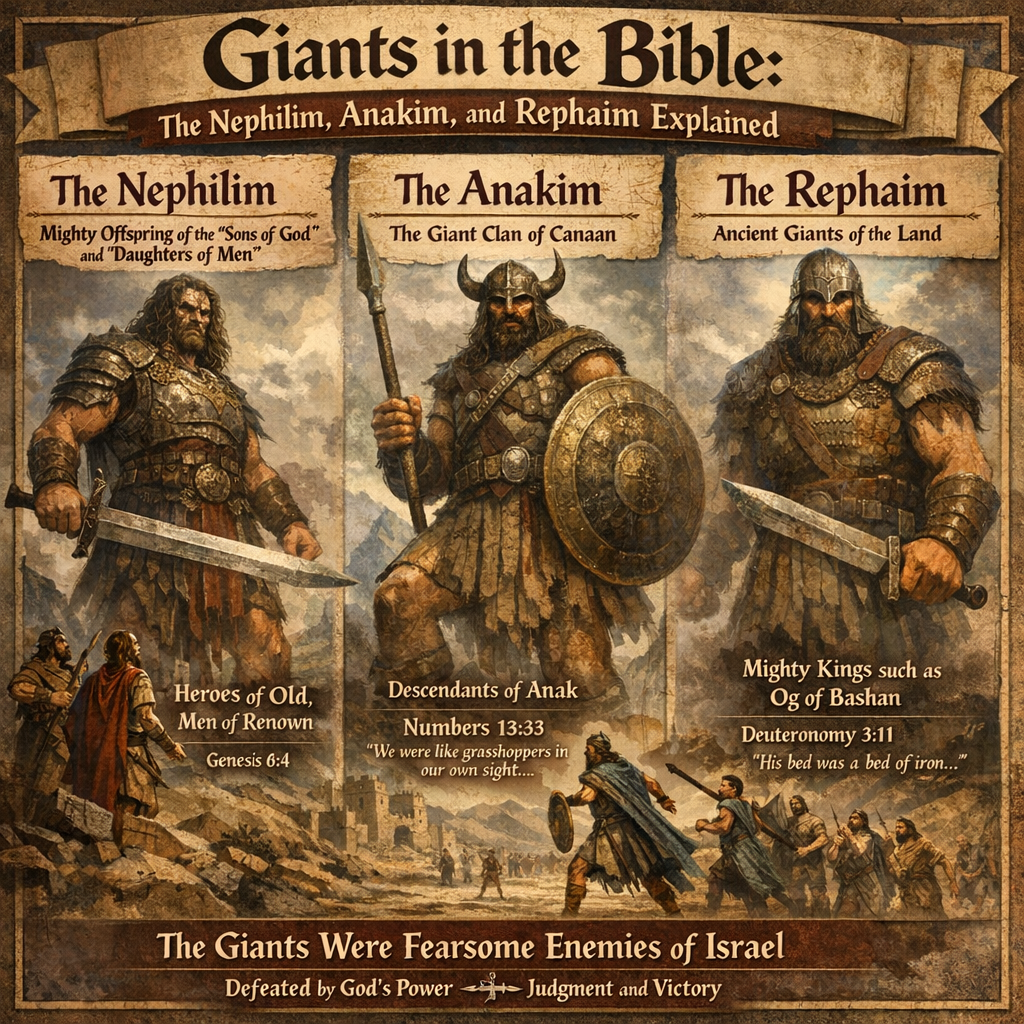
The Bible is full of references to giants — massive, powerful beings who appear across multiple eras of biblical history. From the pre-Flood Nephilim to the towering Anakim whom the Israelite spies feared, to the Rephaim giants encountered in battle by the armies of Israel, the presence of giants in Scripture is not incidental. It is part of a deliberate, ongoing cosmic narrative. So who were these giants? And what does their existence tell us about the unseen war running through the Bible?
The Nephilim: Giants Before the Flood
The Nephilim are first mentioned in Genesis 6:4, in the context of the “sons of God” coming to earth and producing offspring with human women. The word Nephilim is often translated as “giants” but literally comes from a Hebrew root meaning “fallen ones” or “those who cause others to fall.” They were described as “mighty men” and “men of renown” — beings of extraordinary size and power.
The Book of Enoch provides considerably more detail, identifying the Nephilim as hybrid beings — part human, part divine — whose violence and appetite devastated the pre-Flood world. Their insatiable hunger led them to consume everything available and eventually turn on humanity itself. Their corruption was so profound that it became one of the primary reasons God sent the Flood.
Giants After the Flood: How Did They Return?
One of the most persistent questions in biblical studies is this: if the Flood wiped out the Nephilim, why do we see giants again after the Flood? Genesis 6:4 itself seems to anticipate this: “The Nephilim were on the earth in those days, and also afterward…” Some scholars argue that the post-Flood giants represent a second incursion — a renewed attempt by fallen divine beings to corrupt the human bloodline after the Flood failed to end the program entirely.
Others point to Ham’s lineage through Canaan as the conduit through which giant bloodlines persisted. The Canaanite tribes — including the Anakim, Rephaim, Emim, and Zamzummim — all feature large, powerful beings who occupied the land God promised to Abraham’s descendants.
The Anakim: Giants in the Promised Land
When Moses sent twelve spies into Canaan in Numbers 13, ten of them returned terrified. Their report: “We saw the Nephilim there (the descendants of Anak come from the Nephilim). We seemed like grasshoppers in our own eyes, and we looked the same to them.” The Anakim were descended from Anak, who was himself descended from a figure known as Arba. Their presence in Canaan was not accidental — it was a strategic occupation of the land God had covenanted to Israel.
The destruction of the Anakim by Joshua was therefore not simply a military campaign. It was a continuation of the divine war against the corruption that had plagued humanity since before the Flood. Joshua 11:21-22 records that Joshua “destroyed the Anakim from the hill country — from Hebron, Debir, Anab, all the hill country of Judah, and all the hill country of Israel.” Only a remnant survived in Gaza, Gath, and Ashdod — cities that would later produce more giants, including Goliath.
Goliath: The Most Famous Giant
Goliath of Gath is the most recognizable giant in the Bible. Standing over nine feet tall according to most manuscripts, he was a champion warrior of the Philistines who defied the armies of Israel for forty days. His defeat at the hands of the young David in 1 Samuel 17 is one of the most iconic moments in all of Scripture. But Goliath was not the last of his kind. Second Samuel 21 records four subsequent battles against giants from Gath — all descendants of the Rephaim — fought by David’s mighty warriors.
The Rephaim: Giants in History and Prophecy
The Rephaim appear throughout the Old Testament as a well-known class of giant beings. Og of Bashan — described in Deuteronomy 3:11 as having a bed nearly fourteen feet long — was the last of the Rephaim kings. His defeat by Moses and Israel was remembered as one of the great victories of the Exodus. But the Rephaim also appear in the prophetic literature in an eerie context: in Isaiah 14 and 26, they seem to be associated with the inhabitants of Sheol — the realm of the dead — pointing to a connection between the giant bloodlines and death itself.
Why Were the Giants Destroyed?
The systematic destruction of the Canaanite giants was not ethnic cleansing. It was divine warfare. The Nephilim and their descendants represented a persistent supernatural threat to the bloodline through which the Messiah was prophesied to come. Every giant city conquered, every giant king defeated, was a blow struck in the cosmic war that began in Genesis 3 and culminates in Revelation. The seed of the woman and the seed of the serpent were at war — and giants were the weapons deployed against God’s covenant people.
Watch the Full Video on YouTube
Get the Ebook
Want to go deeper into the world of biblical giants, the Nephilim, and the cosmic war that shaped the Old Testament? Jared Lewis’s ebook has you covered.
Follow Jared Lewis
- 📺 YouTube: @JaredLewisBooks
- 📸 Instagram: @JaredLewisBooks
- 🧵 Threads: @JaredLewisBooks
- 🐦 X (Twitter): @JaredLewisBooks
Keep Exploring: Giants, Watchers, and the Biblical Narrative
The Nephilim, Anakim, and Rephaim did not appear in a vacuum. Their origin goes back to the Genesis 6 rebellion of the sons of God. For the complete origin story, read our post on who the sons of God in Genesis 6 actually were.
Mount Hermon was the traditional site of the Watcher descent that produced the Nephilim. Explore its significance in the cosmic war narrative: Mount Hermon and the divine rebellion.
Noah’s Flood was God’s direct response to the Nephilim corruption. Read why the flood was far more than a natural disaster in our post on Noah’s Flood: a cosmic reset.
For the big-picture story of how the giant nations fit into the cosmic war from Genesis to Revelation, see our cornerstone post on the complete story of the Nephilim and the coming kingdom.
For a detailed examination of the hybrid offspring of the Watchers and human women, see Aliens, Nephilim, and Hybrid Beings: How Far Does Scripture Really Go?