Almost everyone who reads the Bible seriously eventually asks the same question: are there other books that should be in here? The question usually comes from a good place. A reader notices a reference to a book they do not recognise — a book quoted or mentioned in passing — and wonders what else is out there. Or they hear about “lost books of the Bible” online and wonder whether something important was kept from them.
The answer is more interesting, and more reassuring, than most of the versions circulating online. There were other books. Some of them were widely read. Some of them were even quoted by biblical writers. And the reasons they were left out are not a mystery — they are part of the history of how the Bible came to be, and that history is worth knowing.
First, what do we mean by “lost books”?
The phrase “lost books of the Bible” covers several different kinds of writing, and keeping them straight helps a lot. Some are books that are mentioned in the Bible itself but have not survived — works like the Book of Jasher or the Book of the Wars of the Lord, which are named in passing and then never seen again. Some are books that did survive, like the Book of Enoch, the Book of Jubilees, or the Gospel of Thomas, but were not included in the canon. And some are books that were written much later, under the name of an apostle or another famous figure, and were never seriously considered for inclusion at all.
The books most readers are asking about fall into the middle group: writings from the centuries around Jesus that were known, copied, and read by real communities of believers, but that were not finally received as Scripture. Understanding why means understanding how the canon was formed in the first place.
How the canon was formed
The Bible was not handed down in a single bound volume. It came together over time, as communities of believers recognised certain books as authoritative — books that carried the voice of God, that were consistent with what had already been received, and that the churches found themselves returning to again and again in worship and teaching.
For the Old Testament, that process stretched over centuries. The books of the Law and the Prophets were recognised early. The Writings took longer. Different Jewish communities in the ancient world did not all use exactly the same list, and that is part of the reason different Christian traditions today have slightly different Old Testaments. For the New Testament, the process was faster but still gradual. The four Gospels, the letters of Paul, and most of the other books were widely used and recognised fairly early. A handful of books — Hebrews, James, 2 Peter, Revelation — took longer to be accepted everywhere, and a handful of other books were read in some places but not finally included.
What guided the process was not a single vote or a single council, despite what is often claimed online. It was the slow, shared judgment of the churches: which books were apostolic in origin or in authority, which were consistent with the faith already received, which were used in worship across different regions, and which had stood the test of time. Books that met those tests were received. Books that did not were set aside, even if they were popular, even if they were edifying, and even if they contained true things.
The books themselves
Take the Book of Jasher, one of the most searched-for of these writings. It is mentioned in Joshua and in 2 Samuel, which is why so many readers want to find it. The book that circulates today under the name of Jasher, however, is a much later work, and the original book mentioned in the Bible has not survived. That is a genuinely lost book — lost in the ordinary sense that its text is gone, not in the sense that someone hid it.
The Book of Jubilees is a different case. It survived, and it was influential, especially in some Jewish communities. It retells the stories of Genesis and Exodus with added detail, dividing history into periods of forty-nine years. It was read widely, but it was not received as Scripture by most Jewish or Christian communities, in part because its additions to the biblical story were seen as going beyond what had been received, and in part because its authority was never established in the way the books of the Law were.
And then there is Enoch, which deserves its own discussion — and has one on this site. Enoch was widely read in the ancient world, it influenced the language of the New Testament, and it is still canonical in the Ethiopian Orthodox Church. In most traditions, though, it was read without being received as Scripture, for reasons of authorship and content that are covered in the Enoch article.
Why “left out” is the wrong frame
It helps to stop thinking of these books as books that were “left out,” as if someone went through a finished Bible with a pen and crossed them off. The canon was not a finished list that lost books. It was a list that grew as communities recognised books, and some books were never recognised in the first place.
That frame changes the question. Instead of asking who removed a book, it is better to ask why a book was not received. Was it written too late to be apostolic? Did it teach something at odds with the faith the churches had already received? Was it used only in one region, rather than across the wider church? Was its authorship uncertain? Those are the questions the early churches asked, and they are the questions that still make sense to ask today.
How to explore them well
If you want to read the books that did not make the Bible, do it with the same care you would bring to any historical reading. Read them alongside the Bible, not instead of it. Notice what they add to your understanding of the ancient world, and notice where they disagree with the Bible or with each other. Be cautious about modern editions and translations — some are scholarly and careful, others are sensational and unreliable, and the difference matters.
That question leads back to the Bible itself, which is where it should lead. The lost books are worth knowing about. They are not worth losing the Bible over.
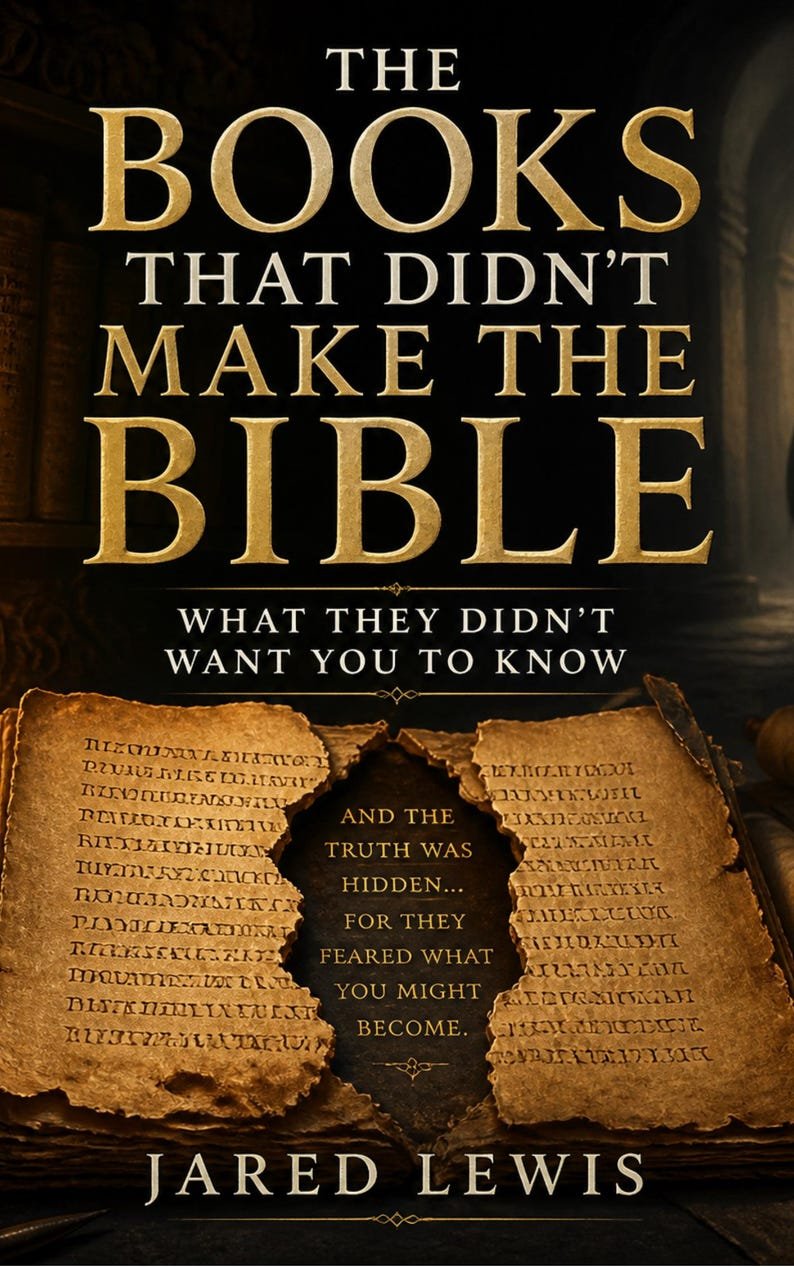
Get the Book: The Books That Didn’t Make the Bible: What They Didn’t Want You to Know — $5.00, digital PDF e-book from the JaredLewisBooks shop on Etsy.
Browse all the books on the Books page.