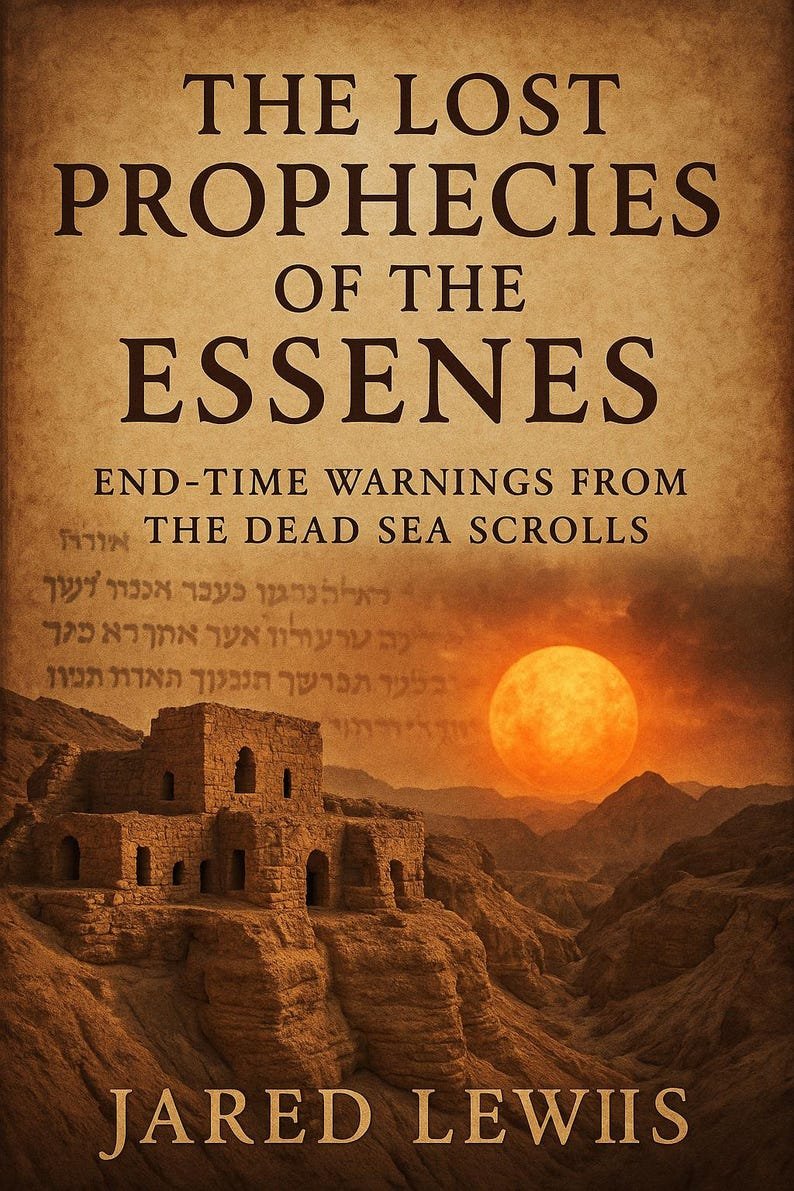
In the middle of the last century, a shepherd looking for a lost goat in the cliffs above the Dead Sea stumbled on something that would change biblical scholarship. In a cave near Qumran, he found clay jars holding ancient scrolls — and over the years that followed, hundreds more manuscripts were found in the caves nearby. Together, they became known as the Dead Sea Scrolls, and they remain one of the most important archaeological discoveries ever made.
The Scrolls have been the subject of endless speculation. Some of that speculation is fair. Some of it is not. This article sticks to what can actually be shown: what the Scrolls are, who wrote them, what they say about the end times, and why they matter for anyone who reads the Bible today.
What the Scrolls are
The Dead Sea Scrolls are a collection of manuscripts found in caves near the ancient settlement of Qumran, on the north-west shore of the Dead Sea. They include copies of books from the Hebrew Bible, along with many other writings — rules for community life, hymns, prayers, commentaries on Scripture, and visions of the future.
The scrolls were written and copied over a period of centuries, and the community that produced many of them is generally identified with the Essenes, a Jewish group known from ancient historians for their strict way of life and their expectation that God was about to act decisively in history. The Essenes lived apart from the Temple establishment in Jerusalem, kept a strict calendar, shared their possessions, and studied Scripture with an intensity that shaped everything they wrote.
That context matters, because the Scrolls are not a single book with a single message. They are a library — the working library of a particular community, at a particular time, with particular hopes and fears. Reading them well means reading them as that community’s books, not as a secret code for the present day.
What the Essenes believed about the end
The Essenes believed they were living in the last days. That belief shaped their whole way of life. They saw themselves as the faithful remnant, set apart from a corrupt world, waiting for God to intervene. Their writings look forward to a final conflict between the forces of light and the forces of darkness, to a judgment in which the wicked would be destroyed and the righteous vindicated, and to a renewed world in which God’s rule would be visible and complete.
The most famous of their end-times writings is often called the War Scroll. It describes a great final war, fought in stages, between the Sons of Light and the Sons of Darkness, with angels fighting alongside human beings. It is vivid, detailed, and dramatic — and it is also a vision, not a military plan. The Essenes were not an army. They were a community of prayer and study, and the War Scroll is best read as their way of imagining the victory of God, not as a prediction of a specific battle on a specific date.
The Scrolls also speak of a coming Messiah, or in some texts, of two messianic figures — a priestly one and a royal one. That detail has attracted a great deal of attention, and it should be handled carefully. The Essenes’ expectations were shaped by their own reading of Scripture, and they do not map neatly onto later Christian teaching. What they do show is that the idea of a coming deliverer, and of a final judgment, was very much alive in the Judaism of the time — which is the world in which Jesus and the apostles lived and taught.
What the Scrolls do not say
It is just as important to say what the Scrolls do not say. They do not predict specific events in the modern world. They do not name modern nations, modern leaders, or modern dates. They do not contain a hidden timetable for the end of the world, and they do not offer secret knowledge that the rest of the Bible lacks. Anyone who claims to have found a specific modern event in the Scrolls is reading the modern event into the Scrolls, not reading it out of them.
The Scrolls also do not overturn the Bible. One of their greatest gifts to scholarship is, in fact, the opposite: the biblical manuscripts among the Scrolls are remarkably close to the Hebrew text that has been handed down through the centuries. That means the text of the Old Testament we read today is not a late invention. It is, in its essentials, the text that was being copied and read more than two thousand years ago. For readers who worry about whether the Bible has been changed beyond recognition, that is a genuinely reassuring finding.
Why the Scrolls matter for Bible readers
The Scrolls matter for three reasons, and none of them requires sensationalism. First, they give us the oldest known copies of the Hebrew Bible, and they confirm that the text has been preserved with remarkable care. Second, they give us a window into the Judaism of the Second Temple period — the world of the Pharisees, the Sadducees, the Essenes, and the many other groups who were reading Scripture and waiting for God to act. That world is the world of the New Testament, and understanding it helps us understand the New Testament better.
Third, and most simply, they show us people who took Scripture seriously enough to build their whole lives around it. The Essenes were not casual readers. They studied, they prayed, they waited, and they wrote. Their expectations about the end were not always right, and their community did not survive. But their seriousness is worth respecting, and their writings are worth reading — not as a source of secret predictions, but as a witness to how God’s people in a hard time held on to hope.
That is the right way to approach the Dead Sea Scrolls: not as a puzzle to solve, but as a library to learn from. Read them for what they are — the books of a faithful, expectant community, waiting for God to put the world right — and they will reward the reading. Read them for what they are not — a code for the evening news — and they will only disappoint.
Get the Book: The Lost Prophecies of the Essenes: End-Time Warnings from the Dead Sea Scrolls — $5.00, digital PDF e-book from the JaredLewisBooks shop on Etsy.
Browse all the books on the Books page.