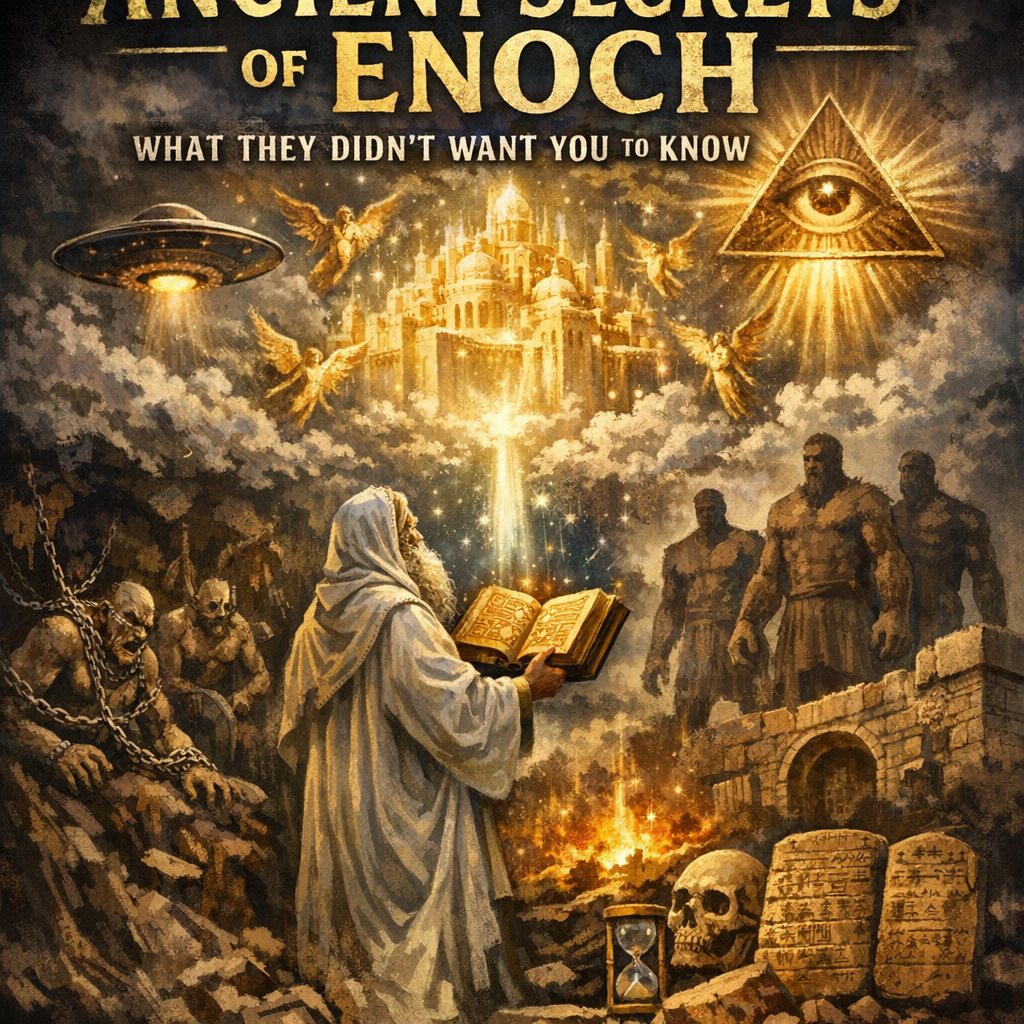
If you have spent any time reading about the Bible’s stranger corners, you have probably run into the Book of Enoch. It shows up in YouTube documentaries, in social media threads, and in conversations about angels, giants, and the end of the world. Some people treat it like a lost key to everything. Others warn against it entirely. Most readers just want a straight answer: what is this book, what does it actually say, and why is it not in the Bible most Christians read today?
That is the question this article tries to answer, the way this site tries to answer everything — Scripture first, secrets second. That means starting with what we can actually show from history and from the texts themselves, and being honest about where the evidence stops.
A book with a famous name
The Book of Enoch is named for Enoch, the figure from Genesis who is described as having walked with God and then being taken, rather than dying in the ordinary way (Genesis 5:24). That short, mysterious description has made Enoch a magnet for curiosity for a very long time. The book that bears his name is not a single short writing, though. It is a collection of visions and teachings that grew up over time, written in the centuries before Jesus, and preserved in different forms in different traditions.
The version most people mean when they say “the Book of Enoch” is usually called 1 Enoch. It is made up of five sections: the Book of the Watchers (chapters 1–36), the Book of Parables (37–71), the Astronomical Book (72–82), the Book of Dream Visions (83–90), and the Epistle of Enoch (91–108). The Watchers section tells of 200 angels who descended to Mount Hermon, took human wives, and fathered the Nephilim. The Parables contain visions of heaven and of the Son of Man — a title Jesus later used constantly. The Dream Visions sweep through the whole history of Israel in allegory. It is dramatic material, and it is easy to see why it captures the imagination. It is also the reason the book needs to be read carefully rather than breathlessly. Drama is not the same thing as doctrine, and an old text is not automatically a reliable one.
The prophecy Jude quoted
The single most important fact about Enoch’s standing in the early church is this: the New Testament quotes it by name. Jude 1:14–15 says, “Enoch, the seventh from Adam, prophesied about them: ‘See, the Lord is coming with thousands upon thousands of his holy ones to judge everyone.'” That is a near-verbatim quotation of 1 Enoch 1:9. Jude treats Enoch’s words as prophecy — not as a curiosity, but as an authoritative prediction.
The prophecy itself is aimed at the Watchers: the divine beings who crossed the boundary God set for them in Genesis 6. According to Enoch, Enoch himself was sent as a messenger to announce their condemnation. They would not be forgiven. They would be bound in darkness until the final judgment. That matches what the New Testament says in 2 Peter 2:4 and Jude 1:6 about angels who sinned being kept in chains of darkness, awaiting judgment. Enoch’s prophecy was not limited to the pre-Flood world, either. It looked forward to a final judgment at the end of history, when God would come with His holy ones to judge the ungodly — the same picture Revelation paints at the end of the age.
Early church fathers knew this text well. Tertullian argued explicitly for its canonicity, pointing to Jude’s quotation as proof. Origen, Irenaeus, Clement of Alexandria, and Justin Martyr all cited or used it. For the first few centuries of Christianity, Enoch was widely read and respected.
Why it was left out
So why is the Book of Enoch not in most Bibles today? The short answer is that the communities that settled the canon — the list of books recognised as Scripture — did not include it, with one notable exception. The Ethiopian Orthodox Tewahedo Church has kept 1 Enoch in its canon to this day, which is one reason the complete text survived. In most Jewish and Christian traditions, though, it was read, quoted, and discussed, but not finally received as Scripture.
There are a few reasons for that, and they are worth stating plainly rather than turning into a conspiracy. First, the book’s authorship was uncertain. It claims the name of Enoch, but it was written long after Enoch’s time, and ancient readers knew that kind of writing — pseudepigrapha, works written under a famous name — was common. Second, its contents were disputed. Its detailed angelology, its account of the Watchers and Nephilim, and its cosmic vision of judgment created theological complexity that some church leaders preferred to avoid. Third, as Gnostic sects used various apocryphal texts to support their teachings, the mainstream church began restricting the canon to distance itself from perceived Gnostic influence. The Council of Laodicea (363 AD) produced one of the earliest canonical lists and excluded Enoch; the Synod of Hippo (393 AD) and the Council of Carthage (397 AD) further solidified the Western canon without it. Fourth, once excluded, the text became rare in the West — by the medieval period it had virtually disappeared from Western scholarship, until a complete copy was brought from Ethiopia in 1773 by the Scottish explorer James Bruce.
That is a less exciting answer than a story about a cover-up, but it is a more honest one. The history of the canon is a history of careful, sometimes messy, communal judgment — not of a single moment when someone hid a book in a vault.
The Dead Sea Scrolls changed everything
The 1947 discovery of the Dead Sea Scrolls at Qumran was a watershed moment for Enoch scholarship. Among the fragments recovered were multiple copies of the Book of Enoch in Aramaic — more copies than any other non-biblical text at Qumran. This confirmed beyond doubt that the Book of Enoch was not a late forgery but a genuine Jewish text dating to at least the 3rd–2nd century BC. The Qumran community, likely the Essenes, clearly treated it as Scripture. Its exclusion from Western Christianity was a historical decision, not a divine one — and not evidence that the text itself was invented.
How to read Enoch well
If you decide to read the Book of Enoch, read it the way you would read any ancient text: with curiosity, with a Bible open beside it, and with a willingness to ask what the writer was trying to say to people in his own time. Notice what agrees with Scripture, notice what does not, and notice where Enoch is simply filling in gaps that the Bible leaves open. Do not treat every vision as a prediction about the present day, and do not treat every strange detail as a secret code. The book rewards patient reading. It punishes hurried reading.
It is also worth reading Enoch alongside Genesis, Jude, and the book of Daniel. Those are the places where the Bible itself touches the themes Enoch develops — the Watchers, the giants, the judgment, the visions of the end. Read together, they give you a much better sense of the world of Second Temple Judaism, the period in which so much of the New Testament’s language was formed. That context does not change what the Bible says. It helps you hear it more clearly.
Why this still matters
The Book of Enoch matters today for the same reason it mattered in the ancient world: it speaks to people who want to know whether God sees what is happening and whether justice is coming. Its answer is yes — God sees, and God will act. That is a message worth hearing, whether or not Enoch itself is on your shelf of Scripture. And it is a message that sits comfortably alongside the rest of the Bible, which says the same thing in its own voice, again and again.
Related reading
- The Dead Sea Scrolls and the Book of Enoch: What Ancient Manuscripts Reveal
- The Books That Didn’t Make the Bible: What They Are and Why They Were Left Out
- Is Enoch in Heaven? What the Bible Actually Says
Get the Book
Get the full book on Etsy: The Book of Enoch with Ancient Secrets of Enoch: What They Didn’t Want You to Know — $5.00