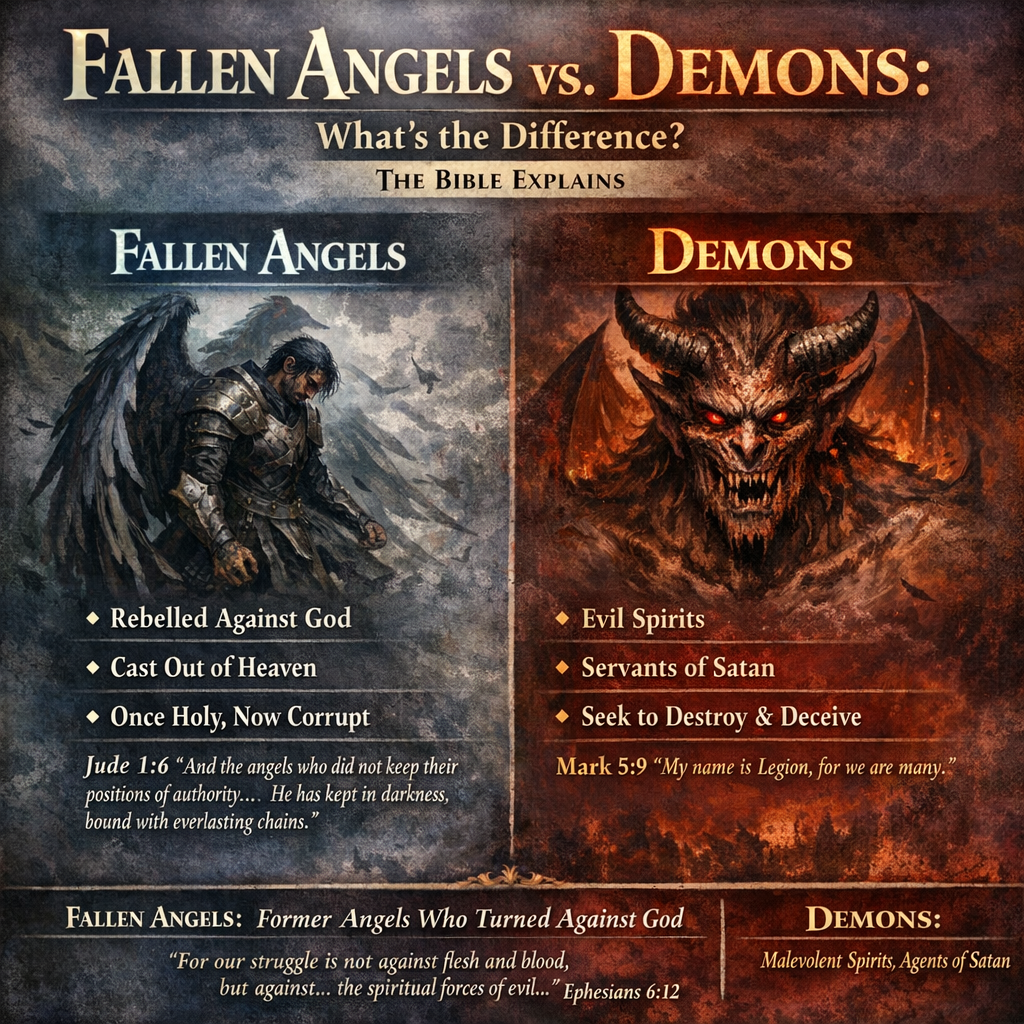

One of the most common points of confusion in spiritual warfare discussions is the distinction — or apparent lack thereof — between fallen angels and demons. Many Christians use these terms interchangeably. But a careful examination of Scripture and second temple Jewish texts like the Book of Enoch reveals that these are two distinct categories of spiritual beings, with different origins, different natures, and different roles in the unseen realm. Understanding the difference isn’t just theological trivia — it has direct implications for how we understand spiritual warfare, oppression, and the end times.
Who Are the Fallen Angels?
Fallen angels in Scripture are members of the heavenly host who rebelled against God. The most prominent example is Satan (Lucifer), whose fall is described in Isaiah 14:12–15 and Ezekiel 28:12–17. But Scripture also describes a specific group of angels who “did not keep their positions of authority but abandoned their proper dwelling” — a reference to the Watchers of Genesis 6 and the Book of Enoch (Jude 1:6). These fallen angels are currently imprisoned: 2 Peter 2:4 states they were “sent to Tartarus” and committed to chains of darkness to await judgment. These are not the beings actively afflicting people in daily life — they are bound.
Who Are Demons?
Demons are the beings that actively work to oppress, possess, and afflict humans in the New Testament. They are cast out by Jesus, they recognize Him as the Son of God, they beg not to be sent to the Abyss (Luke 8:31), and they seek a physical “house” to inhabit (Matthew 12:43–45). The critical question is: if the Watchers are imprisoned and Satan’s angels operate at a cosmic/principality level, where do demons come from?
The Book of Enoch’s Answer: The Disembodied Spirits of the Nephilim
The Book of Enoch provides the most coherent answer to this question found in any ancient Jewish or Christian source. In 1 Enoch 15:8–10, God addresses the Watchers directly: “But now the giants who are born from the union of the spirits and the flesh shall be called evil spirits upon the earth… Because they originated from humans and from the holy Watchers their beginning and primal origin, they shall be evil spirits on earth. Evil spirits they shall be called.”
According to Enoch, when the Nephilim — the hybrid offspring of fallen angels and human women — were killed by the flood and by divine judgment, their disembodied spirits had nowhere to go. They were neither fully human (and thus could not go to the place of human dead) nor fully angelic (and thus could not return to the heavenly realm). They became the wandering spirits of the earth — what we call demons. This explains every behavioral characteristic of demons in the New Testament: they seek physical bodies to inhabit (because they are spirits of beings who once had flesh), they fear the Abyss (their appointed place of judgment), and they are fundamentally opposed to human flourishing.
The Hierarchy of Spiritual Opposition
When we put all of this together, a coherent hierarchy of spiritual opposition emerges:
- Satan: The chief adversary, operating at the highest spiritual authority level; described as the “prince of the power of the air” (Ephesians 2:2)
- Principalities and powers: Fallen angelic beings assigned over nations, systems, and ideologies (Daniel 10, Ephesians 6:12)
- Bound Watchers: The 200 who descended at Hermon; currently imprisoned in Tartarus (2 Peter 2:4, Jude 1:6)
- Demons: Disembodied Nephilim spirits; actively seeking human hosts and working ground-level oppression
Watch the Full Video Study
Watch the complete biblical breakdown of the difference between fallen angels and demons:
Why This Distinction Matters for Spiritual Warfare
Understanding that demons are disembodied Nephilim spirits explains why Jesus addressed them differently than He addressed Satan, why deliverance ministry has a specific character, and why demons respond to the authority of the name of Jesus — because that authority operates at a level above all of them. It also explains why the end times will see an intensification of demonic activity as the return of Christ approaches: as the conditions of Noah’s day are repeated, so will the level of demonic presence and activity on earth.
Read the Full Study
For a comprehensive examination of spiritual warfare, fallen angels, demons, and the Nephilim, read Jared Lewis’s biblical study:
Follow Jared Lewis
- 🎥 YouTube: @JaredLewisBooks
- 📸 Instagram: @JaredLewisBooks
- 🧵 Threads: @JaredLewisBooks
- 🐦 X (Twitter): @JaredLewisBooks
Related Reading: Angels, Demons, and the Fallen Realm
The distinction between fallen angels and demons connects directly to the Genesis 6 narrative. The Watchers who sinned became bound, while their disembodied Nephilim offspring became what Scripture calls demons. For the full backstory, see who the sons of God in Genesis 6 actually were.
The New Testament apostles addressed these categories directly. Paul, Peter, and Jude all wrote about the imprisoned fallen angels and their ongoing influence. Read what they actually said in our post on fallen angels in the New Testament.
The Watchers who produced the Nephilim are described in detail in the Book of Enoch. For background on that ancient text, see who the Watchers were and what the Bible actually says.
For the broader cosmic conflict this all exists within, see our cornerstone post on the cosmic war in Genesis 3.
For a detailed look at the hybrid offspring of the Watchers and human women, see Aliens, Nephilim, and Hybrid Beings: How Far Does Scripture Really Go?
How the Distinction Between Fallen Angels and Demons Changes Our Spiritual Warfare Theology
Understanding the distinction between fallen angels and demons is not theological trivia—it has real implications for how Christians approach spiritual warfare. Paul instructs believers to put on the full armor of God “because our struggle is not against flesh and blood, but against the rulers, against the authorities, against the powers of this dark world and against the spiritual forces of evil in the heavenly realms” (Ephesians 6:12). The vocabulary here—rulers, authorities, powers—suggests a stratified hierarchy of spiritual opposition, not a monolithic enemy. This means that spiritual discernment requires asking not just “is this a spiritual attack?” but “what kind of spiritual reality are we dealing with?” Believers who treat every spiritual problem as demon possession may miss the broader structural dimensions of cosmic rebellion. Those who focus only on high-level angelic powers may fail to engage the very real and personal dimension of demonic harassment in everyday life. A biblical theology of spiritual warfare holds both together—personal and cosmic, internal and structural—because God’s authority in Christ covers every level of the unseen realm.