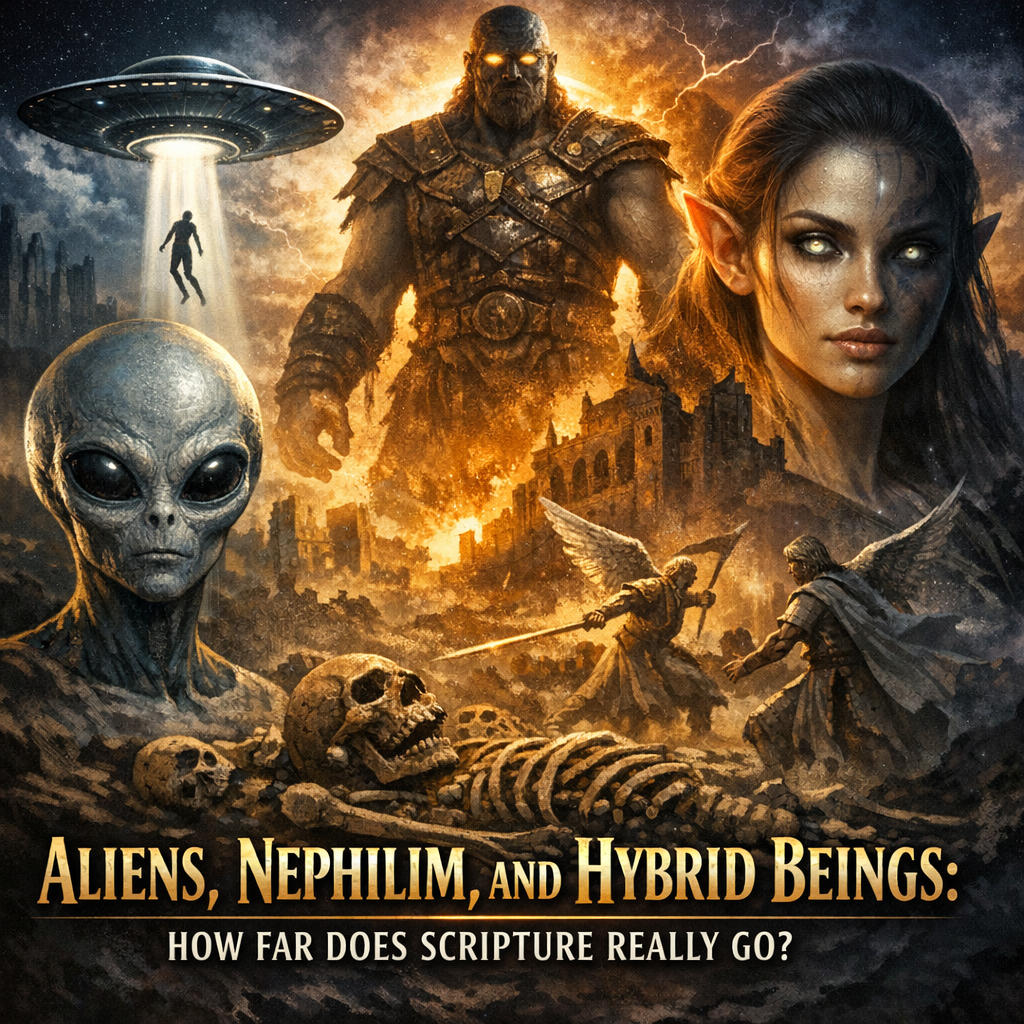
UFO headlines, UAP disclosure hearings, and renewed interest in “ancient aliens” have pushed many Christians back to Genesis 6 with fresh questions. Were the Nephilim alien-human hybrids? Were the “sons of God” fallen angels, human rulers, or something else? And how should believers think about claims of abductions, non-human intelligences, and hybrid beings without either panicking or pretending the Bible has nothing to say? A Bible-first approach begins with humility: Scripture tells us enough to be faithful, but not always enough to satisfy every curiosity. The goal is not to force modern UFO questions into every ancient text, but to let Scripture set the boundaries for what we affirm, what we question, and where we simply say, “We do not know.”
What Genesis 6 Says—and Does Not Say—About Hybrids
Genesis 6:1–4 is one of the most debated passages in the Old Testament. It says that the “sons of God” saw that the “daughters of man” were attractive and took wives from them, and that the Nephilim were on the earth in those days—and also afterward. The passage is brief, mysterious, and deliberately restrained. It does not give us a full mythology of the unseen realm, nor does it explain the mechanics of what happened. Still, it does present a serious transgression before the flood, connected in some way to violence, corruption, and the deepening wickedness of humanity.
Historically, Christians have understood the “sons of God” in several ways. One view sees them as fallen heavenly beings, sometimes connected with the Watchers tradition and passages like 2 Peter 2:4 and Jude 6, where angels are said to have sinned and been kept for judgment. Another view sees them as the godly line of Seth intermarrying with the ungodly line of Cain. A third view understands them as ancient kings or tyrant rulers who abused power and took women as they pleased. The fallen-angel view has strong roots in ancient Jewish interpretation and makes sense of the “sons of God” language used elsewhere in the Old Testament for heavenly beings, but faithful Christians have held different positions.
What Genesis 6 does not say is also important. It does not mention aliens, spaceships, other planets, genetic laboratories, or extraterrestrial civilizations. The Nephilim are described as mighty men, men of renown, and later biblical references connect them with giant clans in the land, but Scripture does not identify them as beings from another world. If there was some kind of forbidden hybridization in Genesis 6, the text frames it in terms of rebellion within God’s created order and the unseen spiritual realm—not science fiction. That distinction matters, especially when modern “Nephilim and aliens” theories turn a short biblical passage into a sprawling speculative system.
Testing Alien Claims by Scripture, Not Speculation
Modern claims about UFOs and the Bible often move too quickly. A strange light in the sky becomes a UAP; a UAP becomes an alien craft; an alien craft becomes proof of extraterrestrial life; then someone connects it to the Nephilim, fallen angels, or end-times deception. Christians should be careful at every step. Scripture calls us to discernment, not gullibility. Not every unexplained event is supernatural, and not every supernatural claim is from God. The Bible gives us categories for angels, demons, principalities, powers, lying signs, and spiritual deception—but it also warns us against myths, fear, and vain speculation.
If intelligent non-human beings are ever publicly claimed through government disclosure or scientific announcement, Christians should not feel that the faith has been overturned. The Bible is not a modern astronomy textbook, but it is the true revelation of the Creator, the fall, redemption, and the lordship of Christ. At the same time, we should test the message attached to any “alien” claim. Does it deny the uniqueness of Christ? Does it reinterpret sin as mere ignorance or evolutionary immaturity? Does it present salvation as secret knowledge, technological advancement, or contact with higher beings? Those questions matter because Scripture teaches that spiritual deception often comes clothed in awe, power, and promises of enlightenment.
The safest path is to keep Jesus Christ at the center. Colossians 1 says that all things were created through Him and for Him, whether visible or invisible, thrones or dominions or rulers or authorities. That includes the unseen realm and anything else in creation we do not yet understand. Christians can study UFOs, UAP disclosure, ancient Near Eastern backgrounds, the Nephilim, and spiritual warfare without becoming obsessed or afraid. But our confidence does not rest in decoding every mystery. It rests in the crucified and risen Lord, who has disarmed the powers and will bring every hidden thing into the light.
So how far does Scripture really go? Far enough to tell us that rebellious spiritual powers are real, that humanity’s corruption is deeper than we often admit, and that God’s judgment and mercy are not abstractions. But Scripture does not give us permission to baptize every alien theory as biblical truth. Genesis 6 may open a window into a strange and sobering episode, but it does not hand us a complete map of UFO phenomena or modern disclosure narratives. For Christians asking about aliens and Christianity, fallen angels and UFOs, or UAP disclosure and Bible prophecy, the answer is not fear-driven speculation. It is careful interpretation, sober discernment, and renewed trust in the authority of Scripture and the supremacy of Jesus Christ.
Related Reading
- The Nephilim Giants: What They Were and Why It Matters
- The Sons of God in Genesis 6: Who They Actually Were
- Who Were the Watchers? Angels or Aliens?
- The Complete Story of the Nephilim from Genesis to Revelation
Get the Book
Go deeper with Jared Lewis’s books on Google Play or browse the collection on Etsy.
What Christians Should Do with Open Questions
The Bible does not resolve every question about the Nephilim, the nature of the “sons of God,” or the precise mechanism by which the pre-flood world was corrupted. What it does provide is a clear theological framework: humanity is uniquely made in God’s image (Genesis 1:26–27), the created order is subject to spiritual rebellion (Romans 8:20–22), God will ultimately judge every spiritual and physical power that has opposed His design (1 Corinthians 15:24–26), and Jesus Christ has already won the decisive victory (Colossians 2:15). Christians can hold open questions with intellectual curiosity while remaining theologically grounded. Acknowledging that the Bible hints at a strange and contested pre-flood world does not require abandoning orthodoxy—it requires the wisdom to distinguish between what Scripture clearly teaches and what it leaves in the mystery of God’s sovereign purposes.