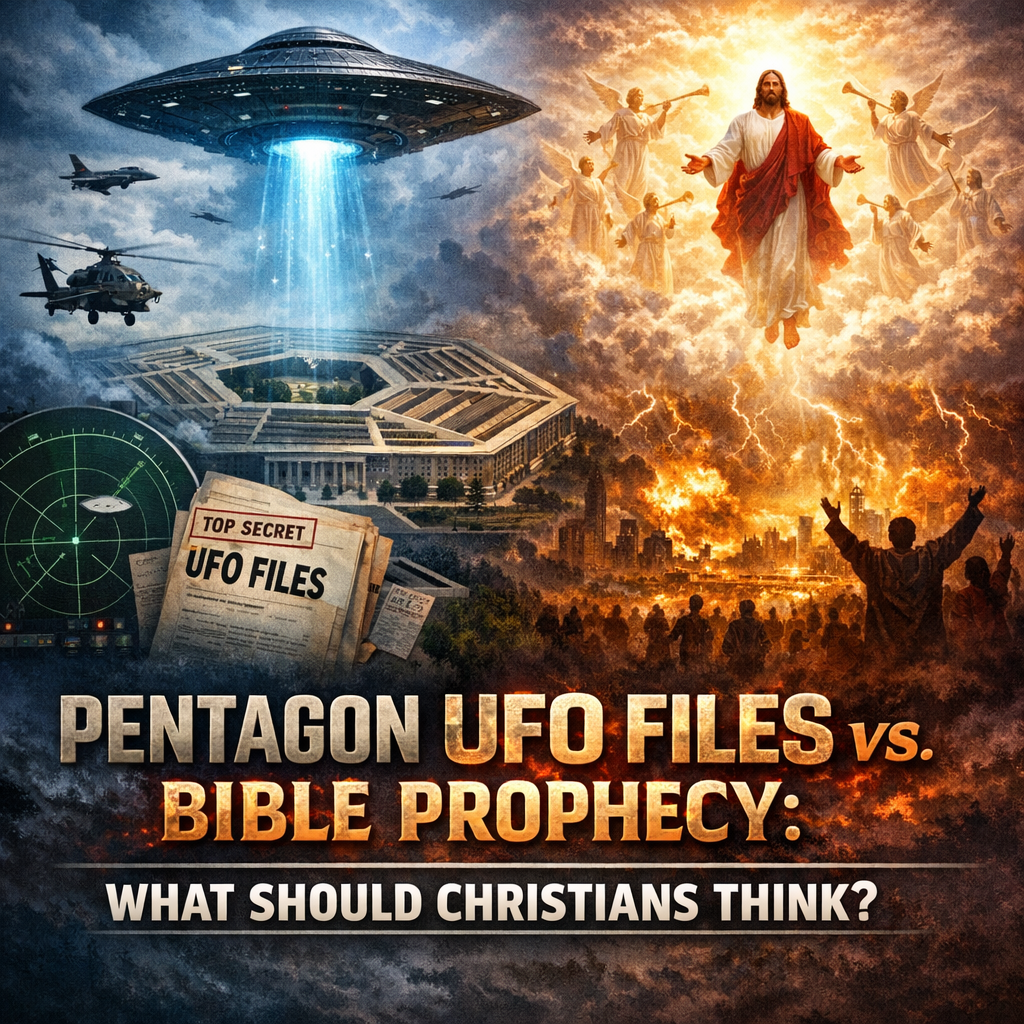
The Pentagon’s UFO files—now usually discussed under the term UAPs, or “unidentified anomalous phenomena”—have pushed an old question back into the public square: Are we alone, and does the Bible say anything about this? For Christians, the first task is not to panic, chase every theory, or force every headline into Bible prophecy. The first task is to ask what Scripture clearly teaches about God, creation, humanity, angels, demons, deception, and the return of Christ. Only then can we think carefully about UFOs and the Bible without drifting into fear or speculation.
What the Pentagon Files Can and Can’t Prove
Pentagon UAP reports can tell us that trained pilots, radar systems, and military personnel have encountered things they could not immediately identify. The 2021 Office of the Director of National Intelligence report acknowledged 143 UAP incidents reported by U.S. government sources between 2004 and 2021 that remained unexplained. A 2022 follow-up raised that number significantly. Congressional hearings have featured military personnel testifying under oath about encounters that exceeded the capabilities of known technology.
While some sightings may involve drones, atmospheric phenomena, sensor malfunctions, or adversarial technology, others remain genuinely unexplained even after thorough analysis. However, “unexplained” is not the same thing as “extraterrestrial,” and “unexplained” is certainly not the same as “Bible prophecy fulfilled.” The Pentagon files document unusual events. They cannot answer deeper theological questions about the nature of reality or humanity’s place in creation—questions that belong to Scripture, not to military intelligence assessments.
The Bible already presents a universe far more populated than modern materialism allows. Angels, fallen angels, demons, the “host of heaven,” the divine council, principalities, and powers are not peripheral themes—they are woven throughout the Old and New Testaments. Christians who hold a biblical worldview should not be surprised when phenomena occur that exceed materialistic explanation. The question is not whether something unusual is happening, but how we interpret it.
How Bible Prophecy Actually Works
One of the most common mistakes Christians make is treating Bible prophecy like a newspaper decoder ring: every current event must correspond to a specific prophetic passage. This approach has been applied to nuclear weapons, the Soviet Union, the European Union, bar codes, microchips, and now UAP disclosure. The problem is not that Bible prophecy is irrelevant to current events—it is. The problem is the method: reading headlines first and then finding Bible passages to match them.
Sound prophetic interpretation reads the Bible in its original context, identifies the principles and patterns it establishes, and then evaluates current events against those principles. When we do that with the UAP phenomenon, several things become clear. Jesus warned extensively about deception in the last days (Matthew 24:4–5, 24). Paul described a coming “mystery of lawlessness” and a “strong delusion” sent upon those who reject the truth (2 Thessalonians 2:9–12). Revelation describes supernatural signs and wonders performed by demonic powers that deceive the nations (Revelation 16:14). These passages do not tell us that UAP disclosure is what they are describing, but they do establish that large-scale spiritual deception is a feature of the last days. That is a pattern worth noting.
Reading UAP Disclosure Through Scripture
The most important lens through which to evaluate UAP disclosure is not eschatological speculation but theological discernment. The key question is not “Is this in Revelation?” but “What does this claim about reality, about God, about Jesus Christ, and about humanity?”
The “ancient aliens” narrative that often accompanies UFO discussion attempts to rewrite the meaning of biblical events. Miracles become misunderstood technology. Angels become extraterrestrial visitors. The resurrection of Jesus becomes a staged event by advanced beings. Scripture, however, presents Jesus as the eternal Son of God, the Word made flesh, who died for sins and rose bodily from the dead (1 Corinthians 15:1–8). This is not mythology or misidentified alien contact. It is the hinge on which all of history turns.
Any narrative—regardless of how well-documented or officially disclosed it becomes—that attempts to replace Christ or relocate His significance within a larger cosmic story that includes other “advanced beings” must be rejected. First John 4:1 instructs believers to test the spirits. The test is not whether an experience is impressive, but whether it confesses the real Jesus Christ.
What Christians Should Actually Do
The right response to Pentagon UAP files and increasing government disclosure is neither panic nor dismissal. Here is a practical framework:
- Stay informed without being consumed. Following UAP news is not inherently wrong. Becoming obsessed with it at the expense of Scripture, prayer, and community is. Christians are called to be wise stewards of their attention.
- Hold the line on Christ. Whatever these phenomena turn out to be, they cannot overturn the historical resurrection of Jesus Christ. The evidence for the resurrection is the foundation of Christian faith—not a fragile assumption that new disclosure could shatter.
- Engage curious neighbors. UAP disclosure creates genuine spiritual openings. People who are asking “Are we alone?” are already open to the idea that the universe is stranger and more populated than materialist science suggests. That openness can become a bridge to the biblical worldview and to Christ.
- Maintain eschatological humility. We do not know exactly how end-times events will unfold. Christians who have been burned by specific predictions that did not come true know the damage that overconfident prophecy interpretation can cause. Hold your specific interpretations loosely while holding the core truths firmly.
Conclusion
Whether a UAP turns out to be advanced technology, misidentified natural phenomena, or something more mysterious, it does not threaten the lordship of Jesus Christ. He is Lord over every dimension of reality—visible and invisible, physical and spiritual, known and unknown. Christians are called to practice discernment under the authority of Scripture rather than swinging between mockery and obsession.
The unseen realm is real. Spiritual deception is real. Human curiosity and spiritual hunger are real. And Jesus Christ remains Lord over all of it. As UAP disclosure continues to develop in the years ahead, the most important thing Christians can bring to the conversation is not a prophetic timeline, but a clear, confident, grace-filled proclamation of the Gospel.