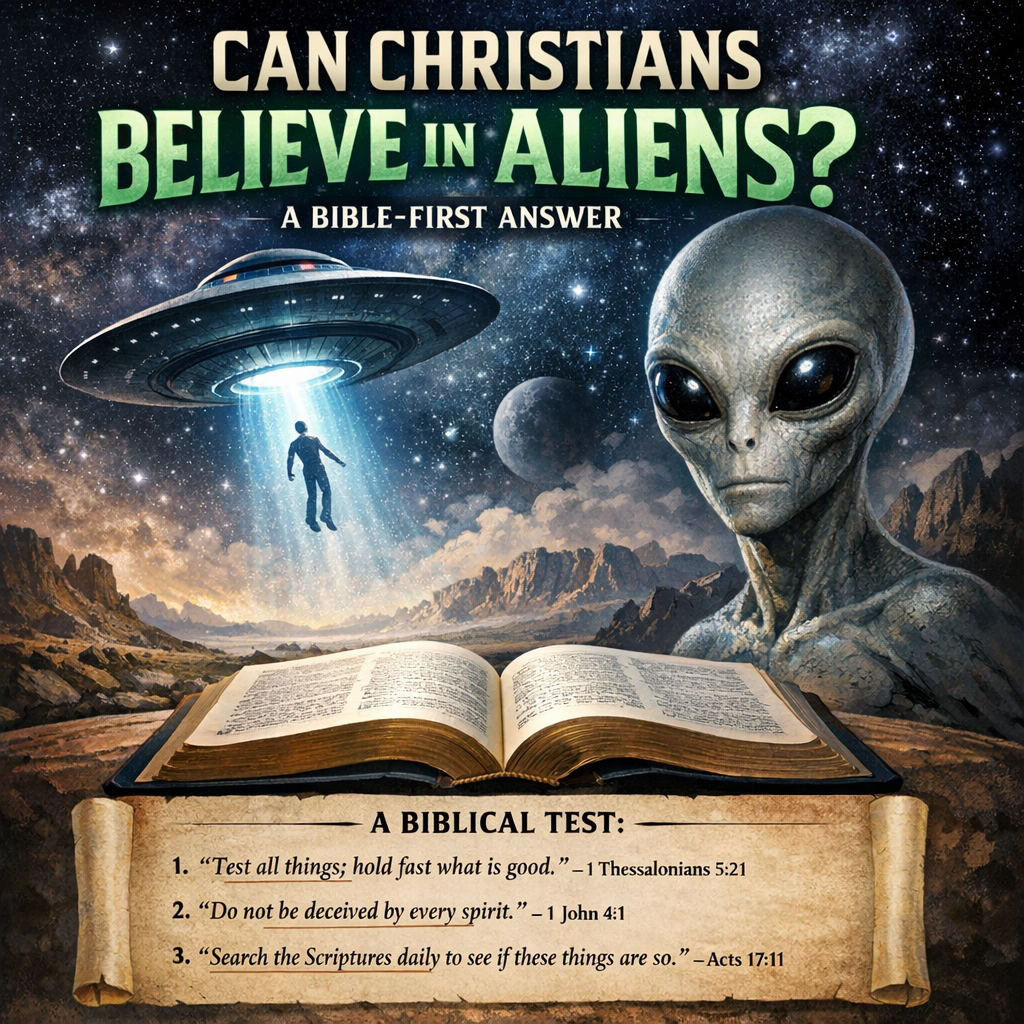
Can Christians believe in aliens? The short answer is: Christians should believe everything Scripture teaches, refuse to build doctrine on speculation, and remain humble where the Bible is silent. UFO headlines, UAP disclosure hearings, abduction stories, and “ancient aliens” documentaries may raise interesting questions, but they do not get to set the agenda for Christian theology. The Bible does.
For believers, the better question is not, “Could there be life somewhere else in the universe?” but, “What has God revealed, and how should that shape the way we interpret strange claims?” Scripture gives us a rich picture of creation, humanity, angels, rebellion, deception, spiritual warfare, and the supremacy of Christ. It does not give us a detailed map of extraterrestrial civilizations.
So a Bible-first answer requires both confidence and restraint. We can be confident that God is Creator of “heaven and earth” and Lord over all visible and invisible realms. We should also be restrained enough to admit that not every light in the sky, alleged encounter, or government report can be neatly labeled from a single Bible verse.
We Start With Scripture, Not UFO Headlines
Christians should not be driven by panic every time a new UFO or UAP story trends online. News cycles come and go. Government disclosures may be significant, misleading, incomplete, or simply confusing. But the Word of God remains steady. A Christian approach to UFOs and the Bible begins with the conviction that Scripture is our final authority, not leaked documents, viral videos, or anonymous military reports.
The Bible opens with God as the Creator of all things: “In the beginning, God created the heavens and the earth” (Genesis 1:1). That means if there are creatures beyond earth, they would not be rivals to God, surprises to God, or exceptions to God’s rule. They would be creatures, not gods. Christianity is not threatened by the size of the universe. In fact, the vastness of creation only magnifies the glory of the One who spoke it into existence.
At the same time, Scripture gives humanity a unique place in God’s purposes. Human beings are made in the image of God (Genesis 1:26–27). The Son of God became truly human in Jesus Christ, died for sinners, rose bodily from the dead, and reigns as Lord over all things. So while Christians can acknowledge the possibility of unknown physical life in the universe, we should not rush to rewrite the gospel around alien speculation. The center of the Christian faith is not disclosure. It is Christ crucified and risen.
What Genesis 6 Does and Does Not Teach Us
Genesis 6 is often pulled into conversations about Nephilim and aliens, especially by those who want to connect “ancient aliens” theories with the Bible. The passage says that the “sons of God” took wives from the “daughters of man,” and that the Nephilim were on the earth in those days (Genesis 6:1–4). Christians have debated this text for centuries. Some understand the “sons of God” as the line of Seth, others as tyrant kings, and others as rebellious heavenly beings—often associated with the Watchers tradition found in Second Temple Jewish literature.
I believe the divine rebellion view deserves serious attention because of how the phrase “sons of God” is used elsewhere in the Old Testament and because passages like 2 Peter 2 and Jude seem to refer to angelic sin connected with boundary-crossing rebellion. But even if one takes that view, Genesis 6 does not teach that space aliens came to earth in flying saucers. The text is concerned with spiritual rebellion, human corruption, violence, and the events leading to the flood. It is not giving us a science-fiction account of extraterrestrial visitors.
That distinction matters. The Nephilim were not “aliens” in the modern sense. The Watchers, if that interpretation is correct, were not biological creatures from another planet but rebellious spiritual beings. This means Christians should be cautious when people try to turn Genesis 6 into a proof-text for UFO disclosure, alien-human hybrids, or secret galactic history. The Bible does speak about the unseen realm, fallen angels, deception, and spiritual warfare—but it does so on its own terms, not according to modern mythology.
So, can Christians believe in aliens? A Christian may believe that God could have created life elsewhere, but we should not claim the Bible teaches it when it does not. Scripture leaves many questions unanswered, and wisdom requires us not to fill those gaps with fear, sensationalism, or internet theories.
When it comes to UFOs, UAPs, abductions, and claims of alien contact, Christians should test everything carefully. Some reports may have natural explanations. Some may involve human deception or psychological experiences. Some may remain unexplained. And some encounters, especially those with spiritual or occult overtones, may fit better within the Bible’s category of deception from hostile spiritual powers than within the category of friendly visitors from the stars.
The safest place to stand is under the authority of Scripture and in the victory of Jesus Christ. He is Lord over heaven and earth, over rulers and authorities, over the seen and unseen. Christians do not need to be afraid of UFO headlines or fascinated by alien speculation. We need clear minds, open Bibles, and deeper confidence in the King who reigns over all creation.
Related Reading
Get the Book
Go deeper with
Jared Lewis’s books on Google Play or browse the collection on
Etsy.
Holding the Question with Humility and Confidence
Christians do not need to feel embarrassed by the question of alien life. It is an honest question raised by genuine curiosity about a universe that is far larger and more mysterious than any of us fully comprehend. The appropriate response is neither panic nor capitulation to whatever narrative the culture promotes. It is the same response Scripture calls believers to in every area of life: hold firmly to what has been revealed, remain humble about what has not, and test everything by the standard of God’s Word (1 Thessalonians 5:21). If genuine non-human intelligence beyond the category of angels ever becomes a confirmed reality, that discovery will not collapse the Christian faith—because the Christian faith rests not on what God created, but on who God is and what He has done in Jesus Christ. That foundation does not shift.