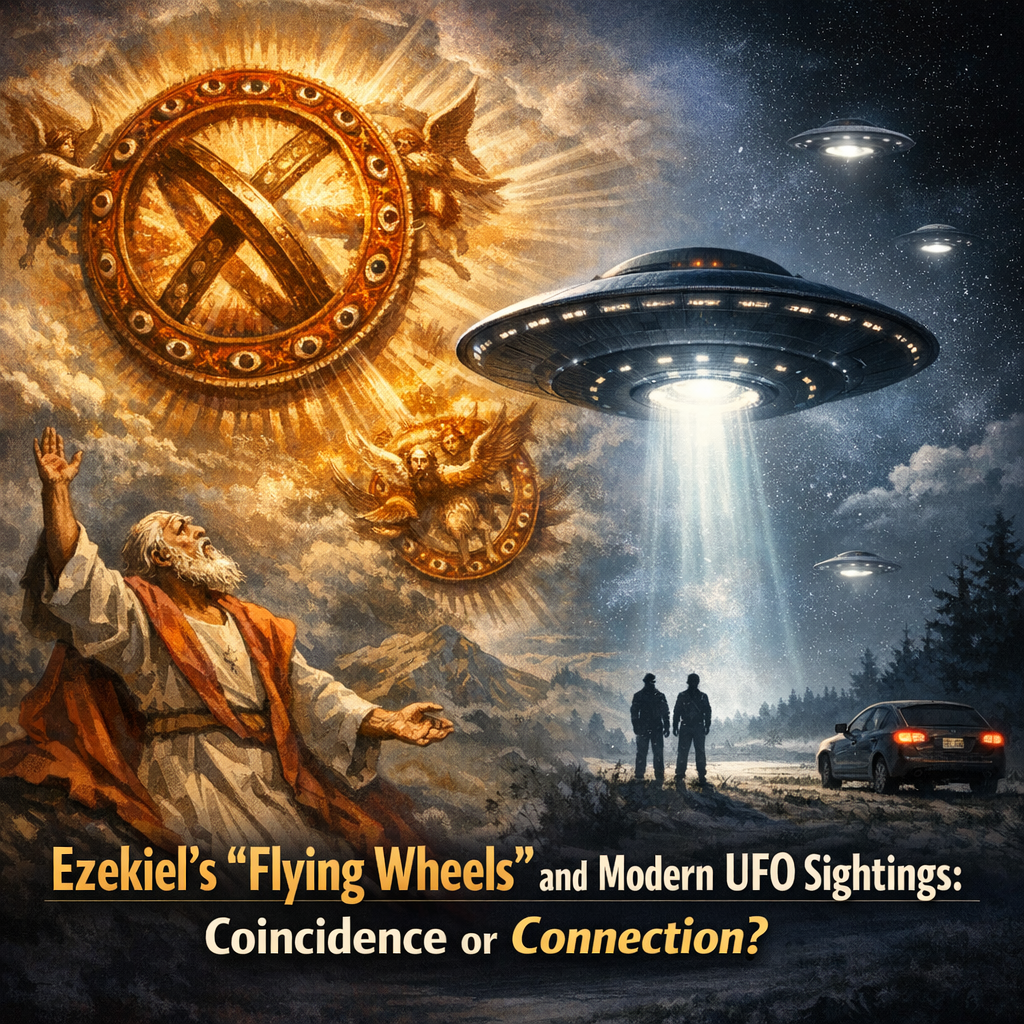
Ezekiel’s vision of “wheels within wheels” has fascinated readers for centuries, and in the age of UFO sightings, UAP disclosure, and renewed public interest in “aliens,” it is not surprising that some have tried to connect Ezekiel 1 with modern reports of strange objects in the sky. But before we rush to identify the prophet’s vision as a spacecraft, we need to slow down and read the passage on its own terms. A Bible-first approach does not begin with headlines, documentaries, or speculation. It begins with the text, the context, and the God who reveals Himself through Scripture.
What Ezekiel Saw: Glory, Not a Spacecraft
Ezekiel 1 describes one of the most overwhelming visions in the Old Testament. The prophet sees a stormy wind, a great cloud, flashing fire, living creatures with multiple faces, wings, and wheels full of eyes. Above them is a throne, and on the throne is a figure of “the appearance of the likeness of the glory of the LORD.” That phrase is critical. Ezekiel is not describing a machine he cannot explain. He is describing the throne-chariot of the God of Israel—what Jewish tradition calls the merkavah, or divine chariot.
The four living creatures described in Ezekiel 1 reappear in Isaiah 6 and Revelation 4, where they are unmistakably associated with the throne of God and with angelic worship. These are not unknown beings—they are the cherubim, the highest order of angelic beings in the Bible, who guard God’s throne and mediate His presence. The wheels full of eyes represent divine omniscience and sovereignty, not mechanical engineering. The entire vision is a theophany: a direct appearance of divine glory to a human prophet.
Ezekiel himself interprets the vision at the end of chapter 1. He falls on his face, overwhelmed, and says: “Such was the appearance of the likeness of the glory of the LORD.” He does not say he saw a vehicle from another planet. He does not describe beings that communicated advanced technology to him. He worships. That response alone tells us what the vision was and who the vision was from.
The Historical Roots of the Spacecraft Interpretation
The idea that Ezekiel’s vision was a spacecraft encounter was popularized in the 1970s, most notably by aerospace engineer Josef Blumrich, who claimed to have reverse-engineered the “craft” described in Ezekiel 1. His book, The Spaceships of Ezekiel, attracted significant attention because it appeared to bring technical credibility to an ancient text. Erich von Däniken’s Chariots of the Gods also featured Ezekiel prominently in its argument that ancient peoples encountered alien visitors.
What these interpretations share is a common starting assumption: that the most plausible explanation for any ancient account of heavenly phenomena is extraterrestrial technology, not genuine divine activity. This is itself a theological commitment masquerading as scientific objectivity. If you begin with the assumption that God does not exist or does not intervene, then you must find a naturalistic explanation for Ezekiel’s vision. But the text does not invite that approach. It presents itself as a direct revelation from the God who created the universe.
Why the Spacecraft Reading Fails Textually
Beyond the theological problems, the spacecraft interpretation also fails on textual grounds. Consider what Ezekiel actually describes: the living creatures have four faces (lion, ox, eagle, human), four wings, and calves’ feet. The wheels are described as glowing like beryl (a precious stone), intersecting each other, and covered in eyes on their rims. None of these features describe a functioning spacecraft. They describe a vision shaped by the biblical symbolism of divine sovereignty, holiness, and omniscience.
The four faces represent the fullness of creation—wild animals, domesticated animals, birds, and humanity—all gathered in service before the throne of God. The eyes on the wheels represent complete awareness; nothing escapes God’s sight. The intersecting wheels that can move in any direction without turning represent God’s unrestricted freedom and sovereignty over all directions of history and creation. These are theological symbols, not engineering blueprints.
What the Vision Was Actually About
Ezekiel received this vision in a specific historical context. He was among the Jewish exiles deported to Babylon. The great crisis of his day was whether the God of Israel had abandoned His people. Had Babylon’s gods won? Had the God of Israel been defeated by being pushed out of His land?
The vision of the merkavah answered that question directly. The throne-chariot of God appeared not in Jerusalem, not in the temple, but in Babylon—beside the river Chebar, in exile. God had not been defeated. His throne was mobile. His glory was not confined to a building or a geography. He was present with His people even in captivity, and He was revealing Himself in sovereign glory that made the Babylonian empire look small by comparison.
This is the message of Ezekiel 1. It is not a message about alien visitors. It is a message about the God who will not abandon His people, whose glory fills the whole earth, and whose purposes cannot be stopped by human empires or cosmic powers.
Modern UFO Sightings Through a Biblical Lens
None of this means that modern UAP sightings are unimportant or that Christians should dismiss every unexplained aerial phenomenon without thought. The Bible does affirm that spiritual powers operate in the unseen realm and that this unseen realm intersects with the visible world. Ephesians 6:12 describes “spiritual forces of evil in the heavenly places.” Daniel 10 describes an angelic conflict in the heavens that affected events on earth. The biblical worldview is not naturalistic—it takes the unseen realm seriously.
But there is a significant difference between affirming a biblical unseen realm and identifying Ezekiel’s vision as a flying saucer. One is faithful to Scripture; the other distorts Scripture to fit a modern template. Christians can engage genuine questions about UAP phenomena, spiritual deception, and the nature of the unseen realm without abandoning the plain meaning of the biblical text.
Conclusion
Ezekiel did not see a spacecraft. He saw the glory of the Lord—the mobile throne of the God of Israel, surrounded by cherubim, blazing with holiness, arriving in Babylon to commission a prophet and bring hope to a people in exile. That is a far more remarkable event than any alien encounter could be.
The connection between Ezekiel’s wheels and modern UFO sightings says more about our cultural moment than it does about the biblical text. In an age fascinated by the possibility of non-human intelligence and government secrecy about aerial phenomena, it is tempting to read ancient texts through those lenses. The discipline of biblical interpretation requires the opposite: reading modern questions through the lens of Scripture, not Scripture through the lens of modern questions. When we do that, Ezekiel’s vision becomes more powerful, more relevant, and more life-giving than any ancient astronaut theory could ever make it.