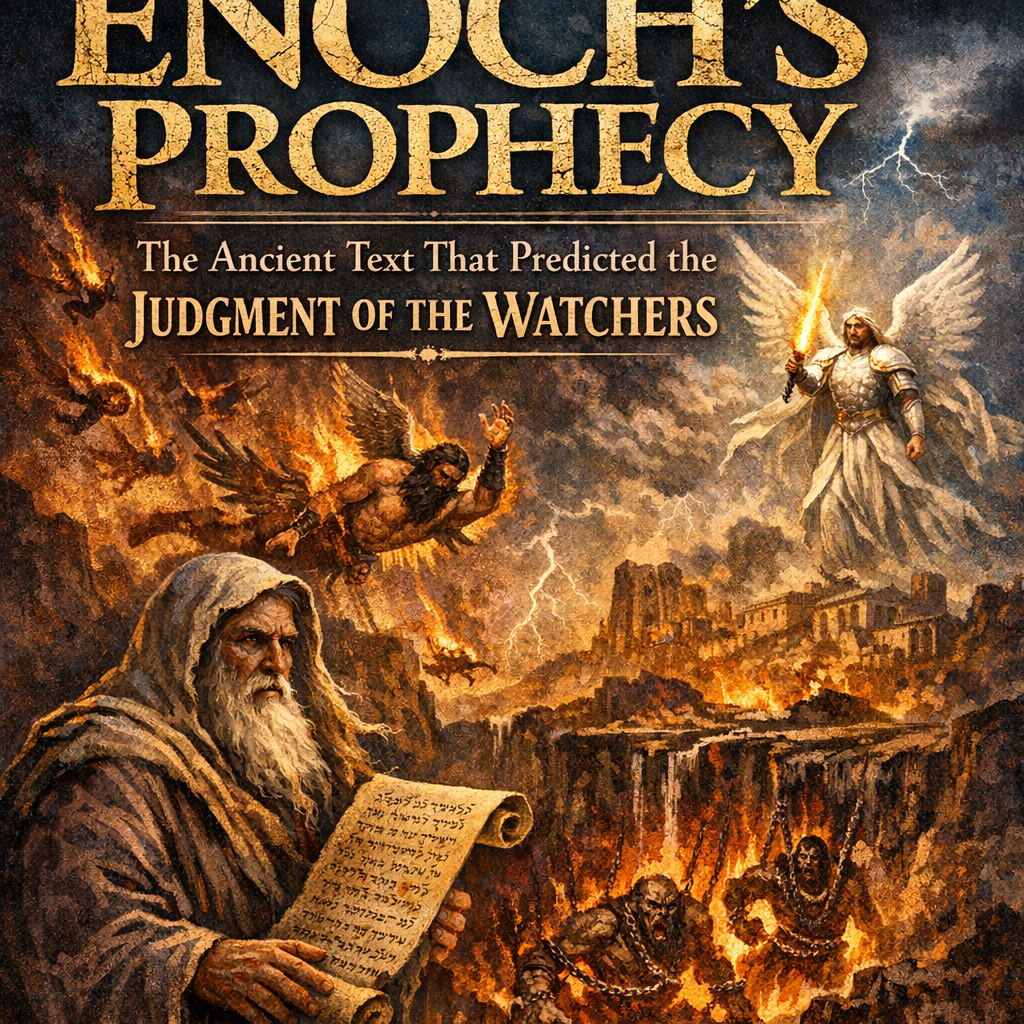
Buried in the pages of the Book of Enoch is one of the most remarkable prophetic passages in all of ancient literature. Written long before the New Testament, the Book of Enoch contains a prophecy attributed to the biblical patriarch Enoch — a man who, according to Genesis 5:24, “walked with God and was not, for God took him.” That prophecy was so significant that the apostle Jude quoted it directly in his New Testament letter. So what exactly did Enoch prophesy? And why does it matter so much today?
Who Was Enoch?
Enoch is one of the most enigmatic figures in the entire Bible. He is listed in the genealogy of Genesis 5, the seventh generation from Adam. Unlike every other person listed in that chapter, Enoch does not die — he is simply taken by God. This extraordinary departure from the pattern of death made Enoch a figure of intense fascination in ancient Jewish literature.
Ancient tradition credited Enoch with receiving visions of heaven, the Watchers, the coming judgment, and the end of days. The Book of Enoch — a collection of texts attributed to him — was widely read and respected in Jewish communities for centuries. Fragments of it were found among the Dead Sea Scrolls, confirming its antiquity and its importance to ancient Jewish believers.
The Prophecy That Jude Quoted
In Jude 14-15, the apostle writes: “Enoch, the seventh from Adam, prophesied about these men saying, ‘Behold, the Lord comes with ten thousands of His holy ones, to execute judgment on all and to convict all the ungodly of all their deeds of ungodliness which they have done in an ungodly way, and of all the harsh things which ungodly sinners have spoken against Him.'”
This passage is taken directly from the Book of Enoch (1 Enoch 1:9). The significance of this cannot be overstated: a New Testament apostle, writing under divine inspiration, explicitly cites the Book of Enoch as prophetic Scripture. He treats Enoch’s words as authoritative and historically real.
The Judgment of the Watchers
The core of Enoch’s prophecy concerns the judgment of the Watchers — the divine beings who descended to earth, corrupted humanity, and produced the Nephilim. According to the Book of Enoch, Enoch himself was sent as a messenger to the Watchers to announce their condemnation. They would not be forgiven. They would be bound in darkness until the final judgment.
This matches the New Testament references in 2 Peter 2:4 and Jude 1:6, which speak of angels who sinned being confined in chains of darkness, awaiting judgment. The prophecy of Enoch is not an abstract theological prediction — it is a specific announcement of judgment against specific beings for specific crimes.
Why Was the Book of Enoch Removed from the Canon?
The Book of Enoch is not part of the Protestant or Catholic biblical canon, though it is considered Scripture by the Ethiopian Orthodox Church and was regarded as authoritative by many early Christian communities. It was ultimately excluded from the Western canon during the patristic period, partly due to debates about its authorship and partly because of growing discomfort with its portrayal of fallen angels.
However, its influence on both the Old and New Testaments is undeniable. Beyond Jude’s direct quotation, the Book of Enoch shaped the vocabulary and theology of Daniel, the Dead Sea Scrolls, and likely the Gospels themselves. Scholars across theological traditions acknowledge that the New Testament writers knew and engaged with the Enochian tradition.
Enoch’s Prophecy and the Last Days
Enoch’s prophecy was not limited to the pre-Flood world. It looked forward to a final judgment at the end of history — a cosmic reckoning when God would come with thousands of his holy ones to judge the ungodly. This eschatological dimension connects directly to the book of Revelation, the teachings of Jesus about the end times, and Paul’s descriptions of the return of Christ.
Understanding Enoch’s prophecy gives readers a panoramic view of history — from the sin of the Watchers before the Flood to the final judgment at the end of the age. The patterns established in Genesis 6 find their ultimate resolution in the events described in Revelation.
Watch the Full Video on YouTube
Get the Ebook
Jared Lewis’s ebook covers the Book of Enoch, the Watchers, and the prophetic framework that connects the ancient world to the end times. Get your copy today.
Follow Jared Lewis
- 📺 YouTube: @JaredLewisBooks
- 📸 Instagram: @JaredLewisBooks
- 🧵 Threads: @JaredLewisBooks
- 🐦 X (Twitter): @JaredLewisBooks
Related Reading: Enoch, the Watchers, and Ancient Manuscripts
Enoch’s prophecy presupposes the full story of the Watchers in Genesis 6. For the biblical foundation of that account, start with who the sons of God in Genesis 6 actually were.
The text of 1 Enoch itself is explored in our foundational post on what the Book of Enoch is and why it matters. And the question of why it was removed from the Protestant canon is addressed separately in why the Book of Enoch was removed from the Bible.
The Dead Sea Scrolls confirmed that multiple fragments of Enoch were preserved and valued in the Second Temple period. Read the connection in our post on what the Dead Sea Scrolls and the Book of Enoch reveal.
The Watchers themselves—who they were and what the Bible actually says about them—is the subject of our dedicated post: who were the Watchers? Angels or aliens?
For a detailed look at the hybrid offspring of the Watchers and human women, see Aliens, Nephilim, and Hybrid Beings: How Far Does Scripture Really Go?
The New Testament Fulfillment of Enoch’s Vision
Perhaps the most stunning aspect of Enoch’s prophecy is how precisely the New Testament authors understood it as being fulfilled—or being fulfilled—in Jesus Christ. Jude quotes directly from 1 Enoch 1:9 when he writes about the Lord coming to execute judgment on all the ungodly (Jude 14–15). The author of Hebrews identifies Enoch as a man of faith who was taken by God (Hebrews 11:5). Peter speaks of spirits in prison who were disobedient in the days of Noah—a direct reference to the imprisoned Watchers of the Enochic tradition (1 Peter 3:19–20). These New Testament passages do not treat Enoch as fringe literature. They treat it as part of the cultural and theological backdrop that their readers understood. Enoch’s prophecy of judgment was not a curiosity—it was preparation. It prepared ancient Israel to understand that God judges rebellious spiritual powers, that His judgment is certain and final, and that the Coming One who would execute that judgment was the Messiah Jesus. Christians reading these ancient texts today stand on the right side of that judgment—not because of their own righteousness, but because of the One who satisfied it on their behalf.