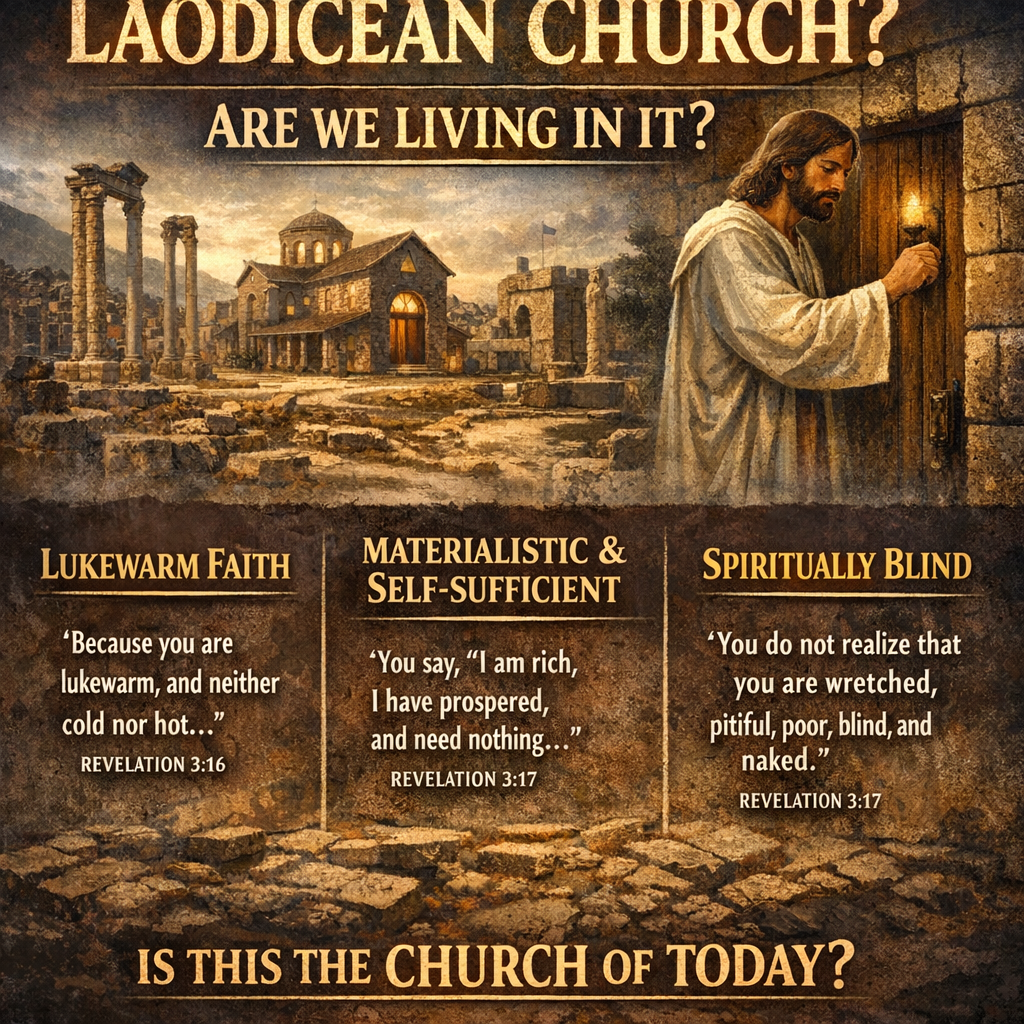

Of the seven letters to the seven churches in Revelation 2–3, none is more sobering — or more universally applicable to the modern Western church — than Christ’s letter to the church at Laodicea. It is the only church that receives no commendation from Jesus. Instead, it is rebuked for being “neither hot nor cold” and threatened with being spat out of Christ’s mouth. The haunting question for every serious Christian in the 21st century is: are we the Laodicean Church?
The Historical City of Laodicea
Laodicea was a prosperous Roman city in the Lycus Valley of modern-day Turkey. Founded in the 3rd century BC, it became one of the most commercially successful cities in the ancient world. It was famous for three things: its banking industry, its production of black wool garments, and its medical school — particularly an eye ointment called Phrygian powder. These three areas of renown form the backbone of Christ’s rebuke in Revelation 3:17–18, where He tells the Laodiceans they are “wretched, pitiful, poor, blind and naked” — the precise opposite of everything they prided themselves on.
The Water Problem: Hot, Cold, and Lukewarm
The famous metaphor of “hot, cold, or lukewarm” water is deeply rooted in Laodicean geography. Six miles to the north sat Hierapolis, famous for its scalding hot thermal springs used for healing. Six miles to the east sat Colossae, known for its cold, refreshing mountain spring water. Laodicea had neither. Its water was piped in through an aqueduct from a warm spring, and by the time it arrived in the city, it was lukewarm — not hot enough to be therapeutic, not cold enough to be refreshing. It was nauseating. Christ’s imagery would have been immediately recognizable to every Laodicean reader.
The Seven Marks of the Laodicean Church
Looking at Revelation 3:14–22 carefully, we can identify seven defining characteristics of the Laodicean church — and they map with disturbing precision onto the modern Western church:
- 1. Self-sufficiency: “I am rich; I have acquired wealth and do not need a thing” (v. 17). A church that does not feel its desperate need for God.
- 2. Spiritual blindness: They cannot see their own condition. This is perhaps the most dangerous mark — blindness to blindness.
- 3. Nakedness: Without the righteousness of Christ, they stand exposed before God despite their external success.
- 4. Lukewarmness: Comfortable Christianity that disturbs no one, challenges nothing, and transforms no one.
- 5. A closed-door relationship with Christ: Revelation 3:20 places Jesus outside the church, knocking. He is not present in the corporate gathering.
- 6. Wealth as a spiritual indicator: The assumption that material prosperity equals divine approval.
- 7. No persecution: Unlike the other six churches, Laodicea faces no external pressure — perhaps because it has so thoroughly conformed to the world that the world sees no threat.
Christ’s Remedy: Buy Gold Refined in Fire
Christ does not abandon the Laodicean church. His remedy is striking: “I counsel you to buy from me gold refined in the fire, so you can become rich; and white clothes to wear, so you can cover your shameful nakedness; and salve to put on your eyes, so you can see.” (Rev. 3:18). The solution to counterfeit spiritual wealth is genuine suffering-tested faith. The solution to spiritual nakedness is the imputed righteousness of Christ. The solution to spiritual blindness is the eye salve of the Holy Spirit’s illumination through the Word.
The Discipline of a Loving Father
What separates Revelation 3:19 from a mere condemnation is this: “Those whom I love I rebuke and discipline. So be earnest and repent.” Christ’s sharp words to Laodicea are not the words of rejection — they are the words of a Father who loves His children too much to allow them to remain comfortable in spiritual stupor. The call is urgent: be earnest (Greek: zelouo, meaning to be zealous, burning with passion) and repent.
Watch the Full Video Study
Watch the complete biblical study on the Laodicean church and what it means for the church today:
Are We the Laodicean Generation?
The evidence is difficult to dismiss. Many prophecy scholars hold that the seven churches in Revelation 2–3 represent not just first-century congregations but successive eras of church history, with Laodicea representing the final church age before the return of Christ. The characteristics of contemporary Western Christianity — seeker-sensitive services, prosperity gospel, biblical illiteracy, cultural accommodation, and the systematic removal of the cross from both preaching and living — all fit the Laodicean profile with unsettling precision. The remedy is the same: earnest repentance and a return to the fear of God.
Read the Full Biblical Study
For a comprehensive study of Bible prophecy, end-times signs, and the state of the modern church, read Jared Lewis’s biblical analysis:
Follow Jared Lewis
- 🎥 YouTube: @JaredLewisBooks
- 📸 Instagram: @JaredLewisBooks
- 🧵 Threads: @JaredLewisBooks
- 🐦 X (Twitter): @JaredLewisBooks
Related Reading: End-Times Discernment and the Unseen Realm
The Laodicean church’s spiritual blindness is especially dangerous in an age of deception. Jesus warned that end-times deception would be intense and widespread. For the prophetic context, see our post on UFOs as signs in the heavens and Luke 21.
The cosmic war that frames all of end-times prophecy began long before Revelation. For the complete story of that conflict from Genesis through the coming kingdom, see our cornerstone post: the complete story of the Nephilim from Genesis to Revelation.
Spiritual compromise in the last days is also connected to deception from spiritual powers operating in the unseen realm. Read our post on whether fallen angels masquerade as aliens for how those powers operate today.
Want to go deeper? Jared Lewis’s books on biblical prophecy and the unseen realm are available on Google Play Books and Etsy.
How to Respond to the Laodicean Condition
The letter to Laodicea is not a letter of condemnation—it is a letter of urgent pastoral appeal. The same Christ who rebukes the lukewarm church also stands at the door and knocks (Revelation 3:20). He does not abandon it. He does not write it off. He calls it to repentance and offers Himself as the solution to every deficiency: His righteousness for its nakedness, His truth for its blindness, His refining work for its shallow comfort. The practical response for any Christian who recognizes the Laodicean pattern in their own life is straightforward but costly: repent of self-sufficiency, pursue Christ earnestly in prayer and Scripture, invest in eternal realities rather than temporal comforts, and choose discomfort with God over comfort without Him. The crown Christ promises to the overcomers in every one of the seven letters is not a reward for the elite—it is the inheritance available to every believer who refuses to settle for less than full devotion to Jesus Christ. In a culture that increasingly mirrors Laodicea, the call of Revelation 3 is not a warning for the past. It is a summons for the present.