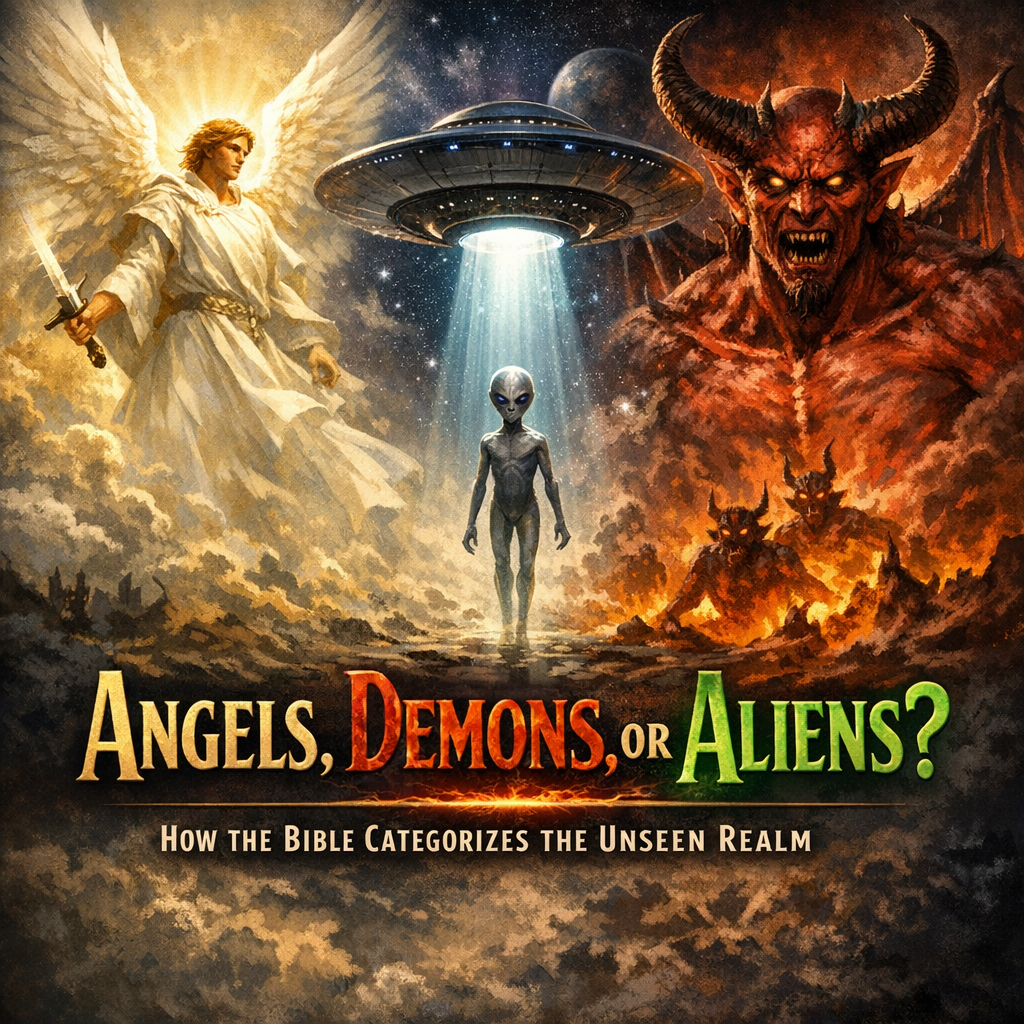
When modern headlines talk about UFOs, UAPs, “non-human intelligence,” or possible alien contact, Christians often ask a fair question: Does the Bible have categories for this? Scripture does not give us a technical manual for every strange light in the sky or every government disclosure. However, it does give us a clear and authoritative framework for understanding the unseen realm. Before we rush to connect UFOs with Bible prophecy, the Nephilim, fallen angels, or end-times deception, we need to slow down and ask what Scripture actually says about angels demons or aliens Bible categories, heavenly beings, and the spiritual powers behind human history. This foundation is essential for any serious study.
What the Bible Means by the Unseen Realm
The Bible presents reality as bigger than the material world we can measure with our senses. From Genesis to Revelation, Scripture assumes the existence of an unseen realm populated by intelligent spiritual beings created by God. These beings are not random or mysterious—they are organized, purposeful, and subject to God’s authority even when they rebel against it. Consequently, for deeper study on this ancient perspective, many scholars point to The Unseen Realm research by Michael Heiser.
The Old Testament speaks of a “divine council” (Psalm 82, Deuteronomy 32:8–9) in which God presides over spiritual beings who hold governing roles. The “host of heaven” is a recurring phrase that describes these beings (Psalm 33:6, 1 Kings 22:19). Daniel’s visions include angelic princes assigned to specific nations, and the text describes a conflict in the heavenly realm that directly influences events on earth (Daniel 10). Building upon this structure, the New Testament adds even more specificity, with Paul describing a hierarchy of “rulers, authorities, cosmic powers, and spiritual forces of evil in the heavenly places” (Ephesians 6:12). This angels demons or aliens Bible framework helps us understand that these beings are part of a structured government. Furthermore, these entities operate within a clear hierarchy.
This is the biblical foundation for thinking about the unseen realm. It is not spooky or speculative—it is the worldview that Scripture presents as the actual structure of reality. The universe is not a cold, mechanistic system of matter and energy operating without any invisible dimension. It is a creation in which visible and invisible realities coexist, interact, and are ultimately governed by the God who made both. Therefore, we must view everything through this lens.
What Angels Actually Are
The word “angel” comes from the Greek angelos and the Hebrew malach, both meaning “messenger.” In Scripture, angels are personal spiritual beings created by God to serve Him, carry His messages, and execute His purposes. They are not omniscient, omnipotent, or omnipresent—these are attributes of God alone. Angels are created beings who serve the Creator. When researching angels demons or aliens Bible distinctions, we see that holy angels always point back to the authority of God. Indeed, their primary role is obedience.
The Bible describes several types of angelic beings. Cherubim appear in Genesis 3 guarding the Garden of Eden, in Exodus 25 flanking the ark of the covenant, and in Ezekiel 1 and Revelation 4 surrounding the throne of God. Seraphim appear in Isaiah 6, crying “Holy, holy, holy” before God’s throne. The archangels Michael and Gabriel are named specifically in Scripture (Daniel 8:16, 10:13, Luke 1:19, 26, Jude 9). These are not small, childlike figures—they are powerful beings before whose appearance humans routinely fall on their faces. In addition, their presence often triggers awe.
What Demons Actually Are
Demons in Scripture are spiritual beings in rebellion against God. The most common view in both Jewish and early Christian tradition is that demons are either fallen angels or the disembodied spirits of the Nephilim (see Genesis 6, 1 Enoch). Whatever their precise origin, their function in Scripture is consistent: they afflict, deceive, and oppress human beings, and they are consistently under the authority of Jesus Christ. Understanding angels demons or aliens Bible classifications requires recognizing the deceptive nature of these fallen entities. As a result, we must be vigilant.
When Jesus cast out demons, He did so with a word. When the disciples cast out demons in His name, they succeeded because of His authority (Luke 10:17). Paul wrote that “at the name of Jesus every knee should bow, in heaven and on earth and under the earth” (Philippians 2:10). Demonic beings are real, active, and dangerous—but they operate under the sovereign permission of God and have been decisively defeated by the death and resurrection of Christ (Colossians 2:15). Because of this, believers have hope.
Where “Aliens” Fit (or Don’t) in the Biblical Framework
Here is where modern questions about UFOs and non-human intelligence intersect with biblical categories. The Bible does not describe extraterrestrial biological entities from other planets visiting Earth. It does not have a category for aliens in the science fiction sense. What it does have is an extensive framework for understanding non-human intelligent beings of a spiritual nature. For a deeper look at this topic, see my post on Aliens in the Bible? What Scripture Really Says About Life Beyond Earth. This resource explores the nuances further.
When people encounter phenomena that seem to involve non-human intelligence—whether in UAP encounters, abduction reports, or contact experiences—the Bible provides a way to ask the right questions. For instance, is this a work of God’s holy angels? Alternatively, could it be a deception by rebellious spiritual powers? We might also ask if it is a natural phenomenon being misinterpreted, or perhaps a combination of psychological and spiritual factors. The biblical framework does not give automatic answers to specific cases, but it does give us the right categories for asking about them. To apply this discernment practically, we must follow the biblical litmus test. Thus, discernment is key.
What we can say with confidence is this: if any being—however it presents itself—delivers a message that contradicts Scripture, undermines the uniqueness of Christ, or offers an alternative path to salvation, the biblical response is to reject it (Galatians 1:8, 1 John 4:1–3). The test is not the impressive nature of the encounter, but the content of the message. This remains the primary angels demons or aliens Bible litmus test for any supernatural claim. Consequently, we must test everything.
Conclusion: The Primacy of the Biblical Framework
A Bible-first approach to the question of angels, demons, and aliens requires believers to be sober-minded and to test every claim against what Scripture actually says. The unseen realm is real. Spiritual beings are real. Deception is real. Above all, Jesus Christ is Lord over all of it—the risen King who has disarmed the principalities and powers (Colossians 2:15) and to whom all authority in heaven and earth has been given (Matthew 28:18). In conclusion, his reign is absolute.
Christians engaging with UAP phenomena and questions about non-human intelligence do not need to choose between intellectual seriousness and biblical faithfulness. The Bible has already given us the most serious and comprehensive framework available for understanding the universe in which we live—a universe that is far more populated, more contested, and more purposeful than either secular materialism or alien mythology can account for. Therefore, we can stand firm.
Why This angels demons or aliens Bible Framework Matters for Christians Today
The resurgence of interest in UFOs, UAPs, and non-human intelligence is not going away. Government disclosures, whistleblower testimonies, and mainstream media coverage have made these topics part of everyday conversation. Christians who have no framework for engaging these questions will either dismiss them entirely—leaving curious people without a biblical answer—or absorb the secular and New Age narratives that often accompany them. Neither response serves the church well. The biblical categories of holy angels, fallen angels, and demonic powers give believers a vocabulary and a theology to engage these claims without fear and without compromise. We do not need to know exactly what every UAP sighting represents; we need to know Who holds authority over every power in the universe. That answer, Scripture gives us clearly: it is Jesus Christ, who is the same yesterday, today, and forever (Hebrews 13:8). Finally, he is our constant security.