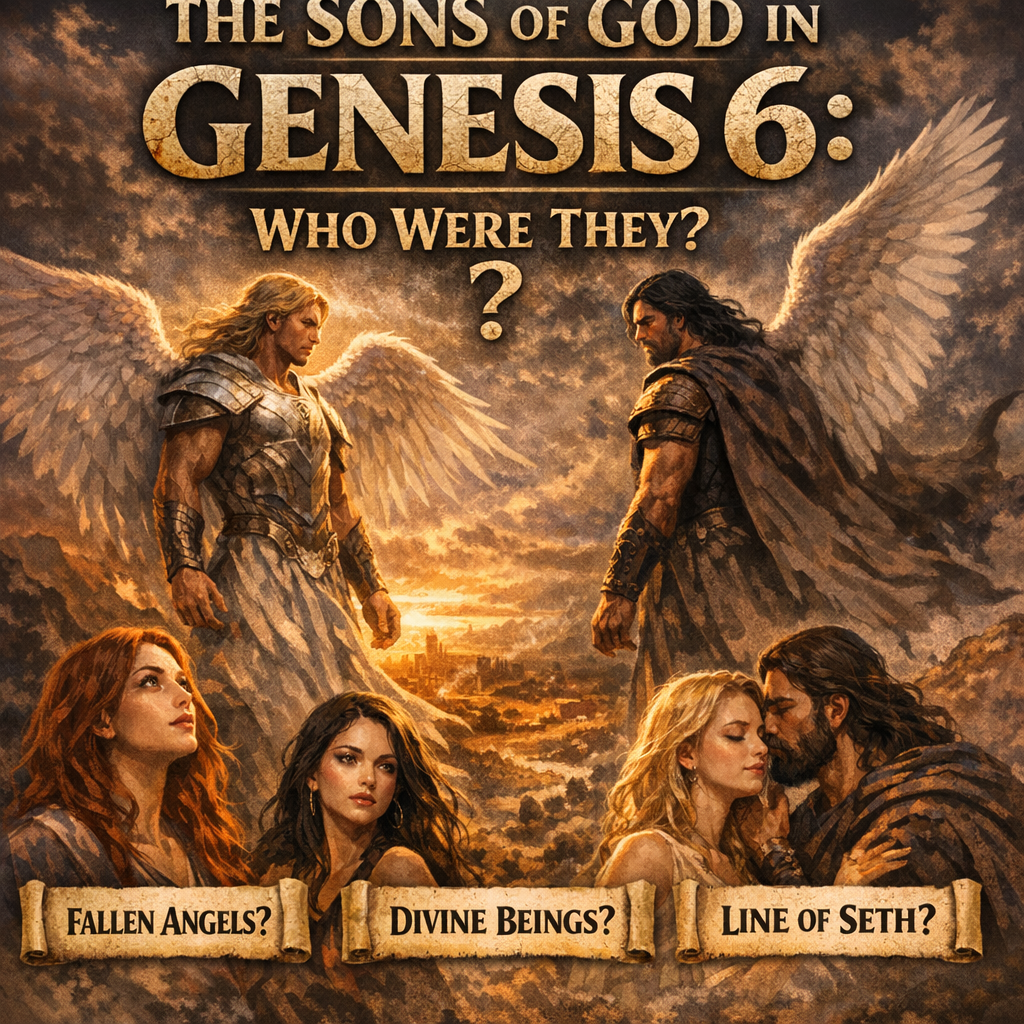

Genesis 6:1–4 contains one of the most debated passages in the entire Bible: “When human beings began to increase in number on the earth and daughters were born to them, the sons of God saw that the daughters of humans were beautiful, and they married any of them they chose.” The question of who these “sons of God” were has divided Jewish and Christian interpreters for millennia — and the answer you choose completely changes how you interpret everything that follows in the Genesis narrative, including the flood, the Nephilim, and the conquest of Canaan.
The Three Major Interpretations
Three main positions have been held throughout church history:
- The Angel View (Watcher Interpretation): The “sons of God” are fallen angelic beings (Watchers) who physically descended to earth, cohabited with human women, and produced the Nephilim. This is the oldest interpretation, held by virtually all Jewish commentators before 200 AD and by most early church fathers.
- The Sethite View: The “sons of God” are the godly descendants of Seth, and the “daughters of men” are the ungodly descendants of Cain. The “marriage” is spiritually mixed marriage between believers and unbelievers. This view became dominant after Augustine (4th–5th century AD) and is still held by many evangelical commentators.
- The Mighty Men View: The “sons of God” are powerful human kings or rulers who took multiple wives by force. This interpretation is a minority view with limited exegetical support.
Why the Angel View Is Most Compelling
The term bene Elohim (“sons of God”) is used in the Old Testament exclusively to refer to divine or angelic beings in every other occurrence: Job 1:6, Job 2:1, Job 38:7, and Psalm 29:1. The same phrase is never used in the Old Testament to describe human beings — not even the godly descendants of Seth. The Sethite interpretation has no textual anchor in the Hebrew; it reads a theological assumption into the text that simply is not there.
Furthermore, the result of the unions in Genesis 6 — the Nephilim — are described as beings of extraordinary size and power: “heroes of old, men of renown.” If the sons of God were merely righteous humans marrying unrighteous humans, why would their offspring be described in these extraordinary terms? Normal mixed marriages between human groups do not produce giants of legendary renown.
New Testament Confirmation
The New Testament confirms the angel interpretation in multiple places. Jude 1:6–7 places the angels who “abandoned their proper dwelling” in immediate contextual proximity to sexual sin: “In a similar way, Sodom and Gomorrah and the surrounding towns gave themselves up to sexual immorality and perversion.” The “in a similar way” comparison implies that the angels’ sin was sexual in nature — exactly what Genesis 6 describes.
2 Peter 2:4–6 links the imprisoned angels, the flood, and Sodom and Gomorrah in a single argument about divine judgment on sexual rebellion. And 1 Peter 3:19–20 references spirits in prison to whom Christ proclaimed His victory after the resurrection — widely understood by early Christians to refer to the imprisoned Watchers of Genesis 6.
Watch the Full Video Study
Watch the complete biblical examination of who the Sons of God in Genesis 6 were and why it matters:
Why This Interpretation Matters
How we identify the “sons of God” in Genesis 6 determines how we understand the entire cosmic conflict running through Scripture: the seed of the woman vs. the seed of the serpent (Genesis 3:15). If the angel interpretation is correct, the flood was not merely a judgment on human wickedness — it was a divine response to a supernatural incursion designed to corrupt the Messianic bloodline. The giants in Canaan were the remnants of that corruption. And Christ’s ultimate victory was not just over human sin but over the entire hierarchy of fallen spiritual powers that had been working against God’s redemptive plan since before the flood.
Read the Full Study
Explore the Sons of God, the Nephilim, and the cosmic conflict in Scripture in Jared Lewis’s comprehensive biblical study: