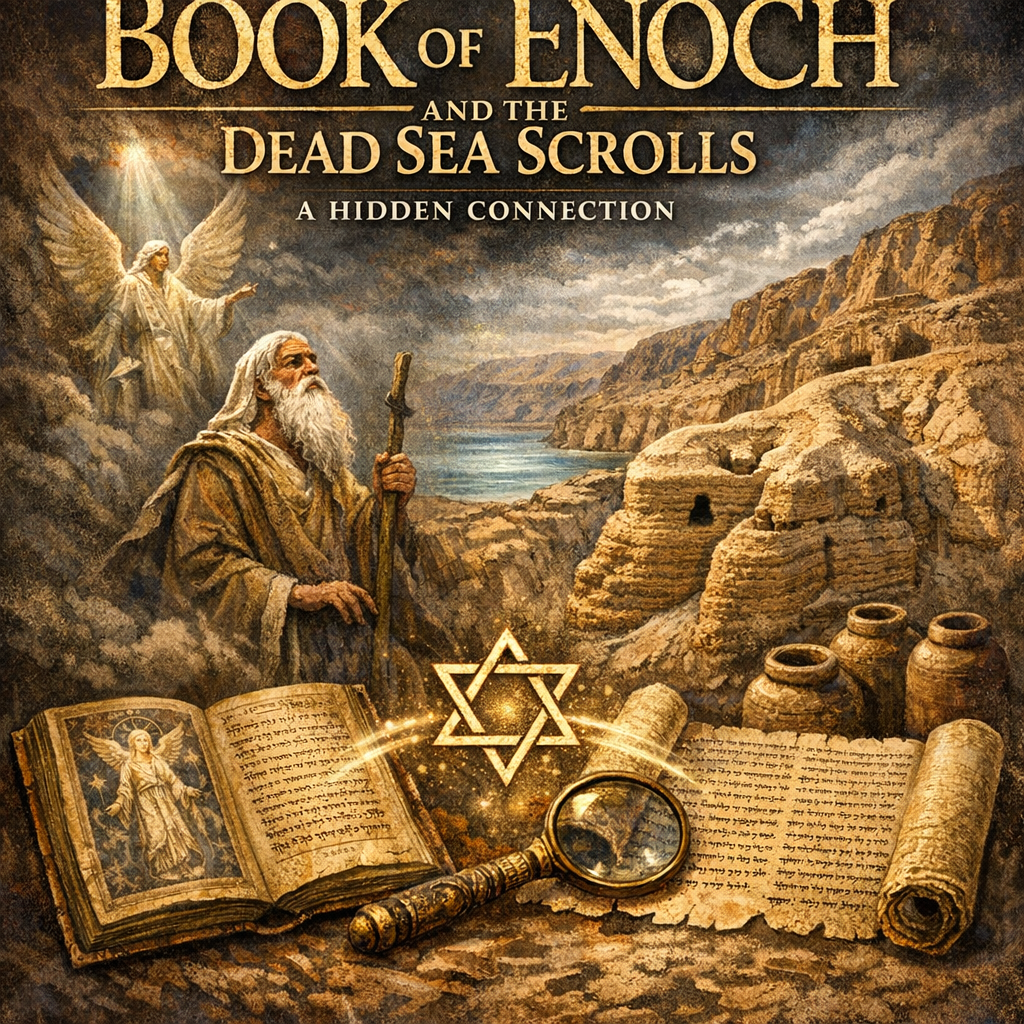

In the spring of 1947, a Bedouin shepherd threw a stone into a cave near the Dead Sea — and heard pottery break. Inside, he found ancient ceramic jars containing scrolls wrapped in linen. This accidental discovery, followed by years of systematic excavation at Qumran, produced one of the most significant archaeological findings in human history: the Dead Sea Scrolls. And among the thousands of fragments recovered, one ancient text appeared more frequently than any other non-biblical work: the Book of Enoch.
The Dead Sea Scrolls: Background
The Dead Sea Scrolls are a collection of approximately 900 documents discovered between 1947 and 1956 in eleven caves near the ancient settlement of Qumran, on the northwestern shore of the Dead Sea in what is now the West Bank. The scrolls date from the 3rd century BC to the 1st century AD, making them the oldest known manuscripts of the Hebrew Bible and related Jewish literature. They include complete or partial copies of every book of the Hebrew Bible except Esther, as well as numerous sectarian texts and apocryphal works.
Enoch Among the Scrolls
Among the apocryphal texts found at Qumran, no single work was more abundantly represented than the Book of Enoch. Scholars have identified at least 12 manuscripts of the Book of Enoch in the Qumran caves, all written in Aramaic. This is more copies than were found of some books that appear in our modern Bible. The implications are significant: the community that preserved these scrolls clearly considered the Book of Enoch to be important, authoritative literature — on par with prophetic and scriptural texts.
Who Preserved the Scrolls?
The Qumran community is widely identified as the Essenes — a Jewish sect that separated from mainstream Judaism during the Second Temple period (roughly 530 BC – 70 AD). The Essenes were noted by ancient writers including Josephus, Philo of Alexandria, and Pliny the Elder for their strict piety, communal living, abstention from marriage (among some groups), and intense focus on apocalyptic scripture and heavenly visions. Their library reflects this orientation: they collected and preserved texts that mainstream Judaism was moving away from, including the Book of Enoch, the Book of Jubilees, and the Temple Scroll.
What the Dead Sea Scrolls Confirm About Enoch
The Aramaic Enoch fragments from Qumran settled several critical debates:
- Antiquity: The oldest Enoch fragments date to the late 3rd century BC, confirming that the Book of Enoch predates the New Testament by at least 200 years and is not a Christian forgery.
- Textual integrity: The Aramaic fragments largely match the later Ethiopian Ge’ez version of Enoch, confirming that the text was faithfully transmitted over centuries.
- Sectarian importance: Multiple copies indicate repeated use and copying, not casual preservation. This was a community that actively studied Enoch.
- New Testament connections: The Enoch manuscripts helped scholars confirm that the New Testament authors — particularly Jude, Peter, and John — were familiar with Enoch’s language, imagery, and theology.
The Missing Book of Giants
One of the most fascinating Enoch-related discoveries at Qumran is the Book of Giants — a text that expands on the Nephilim narrative. Fragments describe the giant offspring of the Watchers having nightmarish visions that foretell the coming flood and their own destruction. The Book of Giants was known previously only from Manichaean sources (a later Persian religious movement), so finding it at Qumran confirmed its Jewish origin and its connection to the Enoch tradition. It gives us the most detailed ancient account of the Nephilim’s fate before the flood.
Watch the Full Video Study
Watch the complete exploration of the connection between the Book of Enoch and the Dead Sea Scrolls:
Why This Connection Matters
The Dead Sea Scrolls connection to the Book of Enoch matters because it destroys the argument that Enoch is a marginal or unreliable text. It was not produced by a fringe group: it was preserved by one of the most serious Jewish communities of the Second Temple period. It predates Christianity. It was known and used by the New Testament authors. And its content — the Watchers, the Nephilim, the coming judgment, the Son of Man — illuminates texts across the entire biblical canon. Ignoring it is a loss the modern church can no longer afford.
Read the Full Study
Go deeper with Jared Lewis’s comprehensive biblical study on Enoch, the Dead Sea Scrolls, and their prophetic significance:
Follow Jared Lewis
- 🎥 YouTube: @JaredLewisBooks
- 📸 Instagram: @JaredLewisBooks
- 🧵 Threads: @JaredLewisBooks
- 🐦 X (Twitter): @JaredLewisBooks
Related Reading: Enoch, the Dead Sea Scrolls, and the Watchers
This post focuses specifically on the manuscript connection. For the broader overview of what the Scrolls and Enoch reveal about the Watchers and fallen beings, see our companion post on what the Dead Sea Scrolls and the Book of Enoch reveal.
The Book of Enoch opens with Enoch’s prophecy against the Watchers. That specific prophecy and its content are analyzed in our post on Enoch’s prophecy and the judgment of the Watchers.
For the question of why Enoch was accepted in some traditions but excluded from the Protestant canon, read why the Book of Enoch was removed from the Bible.
And to understand the complete Book of Enoch from an introductory perspective, start with what the Book of Enoch is and why it matters.
Why the Dead Sea Scrolls Validate Taking Enoch Seriously
One of the strongest arguments for treating the Book of Enoch as more than a fringe curiosity is precisely the evidence from Qumran. The community at the Dead Sea was not a marginal sect preserving obscure folklore—they were a group of devout Jewish scholars deeply committed to Scripture, who preserved more copies of certain Enoch texts than they did of some books that appear in the Protestant Old Testament. They did not consider Enoch to be a late fabrication or a literary curiosity. They treated it as ancient, authoritative, and directly relevant to their own community’s life and expectations. Christians today do not need to grant Enoch canonical status to take that seriously. The Dead Sea Scrolls tell us that the theological world of the New Testament writers was saturated with the Enochic tradition. When Paul, Peter, and Jude use the language of cosmic powers, rebellious angels, and coming judgment, they are drawing on a theological vocabulary their readers already understood. The scrolls give that vocabulary its historical roots—and they confirm that the battle between heaven and earth described in Scripture is no metaphor.